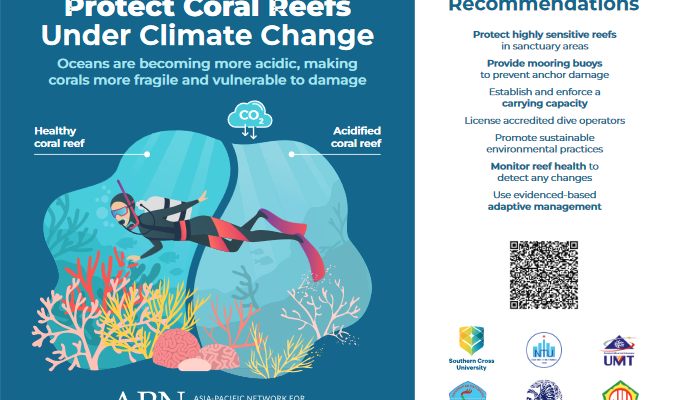
Scuba dive tourism is an important source of income for South East Asia, but it depends on effective management of healthy coral reefs. The combined effects of ocean acidification and marine tourism place intense pressure on sensitive reefs and threaten their ecological and economic sustainability. Coral will become more fragile under acidified conditions, thus increasingly susceptible to damage. This project will build on a meta-analysis to predict the vulnerability of coral reefs in four South-East Asian countries. We will run a workshop to share knowledge between marine biologists, tourism researchers and managers. We will design standardized methodologies and involve research students in interdisciplinary case studies within each country to obtain information on coral reef structure and damage, scuba dive operator awareness, dive/snorkel tourist perceptions and environmental stewardship. We will assess the size and carrying capacity of the marine tourism industry at each location and combine this with coral and stakeholder data in a risk assessment matrix. Each location will be rated for coral reef vulnerability under current and future conditions. We will publish our results in international peer reviewed academic journals and provide public outreach resources. This project will provide leadership and knowledge for effective adaptive management of coral reefs under increasing ocean acidification and tourism, to help ensure the sustainability of marine ecosystem services.
Project leader












Professor Steve Smith, Southern Cross University, Australia
“Our research highlights the need for further, broadscale assessment of coral-reef vulnerability to climate-change throughout the Indo-Pacific region, and a pressing need to identify ‘impact hotspots’ to prioritise management initiatives.”
Alvin Chelliah, Senior Program Manager, Reef Check Malaysia
“This study has played an important role, showing that the dive industry is concerned about the condition of coral reefs due to the impacts of climate change and that they are willing to accept regulations such as best practices standards and carrying capacity limits, if it would help protect coral reefs.”
Professor Gino Limmon, Centre for Collaborative Research on Aquatic Ecosystems in Eastern Indonesia
“This is the first project conducted in Indonesia that provides data on the effect of ocean acidification and marine tourism that can be applied to science-based policy and management to ensure the sustainable utilization of coral reefs in Maluku.”
Project publications

Dive industry perspectives on threats to coral reefs: A comparative study across four Asia-Pacific countries

Scuba divers, coral reefs, and knowledge of ocean acidification

Project final report: CRRP2019-05MY-Benkendorff
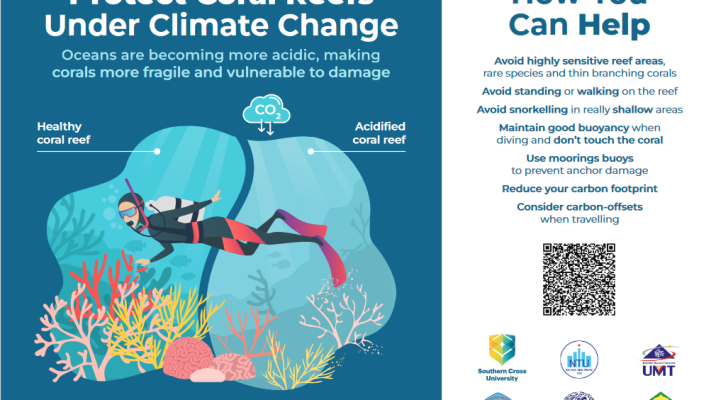
Protect coral reefs under climate change: How you can help