Emerging pollutants (EP) are naturally occurring or synthetic chemicals and substances that have recently been detected or suspected to be present in water and whose toxicity or persistence may pose a risk to human health or the environment (Pontius et al., 2021). EPs in the water environment are an ongoing challenge globally. Recently, chemical pollution has been recognised as a threat to the environment and human health and treated with the same urgency as climate change and biodiversity loss (Rüegg, 2023). Regular monitoring and adapted management of EPs are urgently needed to ensure sustainable development at the global scale.
Several international commitments and targets have been set to regulate EPs in freshwater systems (Sanganyado, 2022). For example, a network of reference laboratories (NORMAN), research centres and related organisations for monitoring of EPs in the environment in Europe already exists (Dulio et al., 2018). However, no similar networks have yet been established in other regions where the aquatic environment is under increasing anthropogenic pressure, such as Asia. Thus, developing a dataset of EPs in the aquatic environment of the large Asian cities is a fundamental necessity for the assessment of pollution levels.
To support surface water management on EPs in this region, the project “Establishing a regional dataset on emerging pollutants to support surface water management of seven large cities of East and Southeast Asia (CRRP2019-10MY-Le)” was undertaken. The project is a collaboration of scientists from different disciplines from six countries: Vietnam, Singapore, France, Thailand, Cambodia and China. This project aims to establish a dataset of EPs in the aquatic environment and assess their potential risks to human health and the environment. Both objectives are essential for the effective management of EP disposal in large cities of East and Southeast Asia.
The results of this work provide a scientific basis for assessing the risk of EP and baseline data to inform governance and decision-making in the region, where human activities significantly affect water quality. The results also support large cities in identifying research needs, planning new management strategies and developing water policies, especially those in developing countries in East and Southeast Asia. The assessments of potential human health and environmental risks posed by these pollutants, together with improved management of EP disposal, contribute to a decision support system for maintaining safe surface water quality and support progress towards the Sustainable Development Goal in Asia.
Achievements
The project has successfully developed a dataset of EPs, including persistent organic pollutants, microplastics, antibiotics and cyanotoxins, in the surface water of seven large cities (Hanoi, Ho Chi Minh, Beijing, Singapore, Seoul, Bangkok and Phnom Penh). Sources of pollution and potential risks of EPs in surface water across the seven studied cities have been pointed out. Our results provide a scientific basis for developing effective water management policies and strategies for the sustainable development of large cities in this region.
The project has significantly enhanced scientific collaboration between countries in Asia and Europe. An online meeting was organised in September 2022. One physical conference titled “Surface water quality in Asian large cities: monitoring and management” was organised in January 2023 in Hanoi. The final physical conference was organised in Hanoi in July 2024. These two conferences are for presenting updated scientific results and discussing scientific topics and the next steps for the project’s activities (dataset construction, project website construction and publications).
The present project has also contributed to training young scientists, lecturers and undergraduate and graduate students. In addition, a short training course on microplastic pollution in water was held in Hanoi in July 2024.
Some details of the project results are presented below:
Publications
The results of the present project have been published in 10 papers in peer-reviewed international journals and 8 papers in national journals. The findings were also presented in 14 oral presentations at international conferences and regional and international global change research networks. The list of publications resulting from this project is accessible on the CRRP2019-10MY-Le project page.
Training
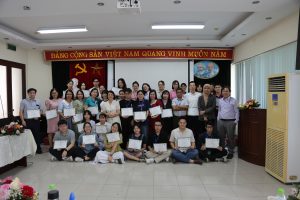
A training course titled “Microplastic pollution in water: monitoring, modelling and ecological risk assessment” was organised at the Institute of Natural Product Chemistry (INPC) in July 2024. Forty-four young scientists, young lecturers and graduate students participated in this training course. Contribution for training graduates and undergraduate students: two PhD students, eight master’s students and 12 undergraduate students.
Websites
Presently, some project information and publications are available on the APN website.
https://www.apn-gcr.org/project/establishing-a-regional-dataset-on-emerging-pollutants-to-support-surface-water-management-of-seven-large-cities-of-east-and-southeast-asia/.
In addition, a website is set up for this project (http://depscaproject.com). This website provides project information and results on EPs in surface water in seven large cities in the East and Southeast Asian regions for a wide audience.
International conferences
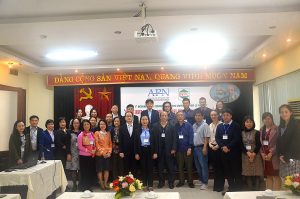
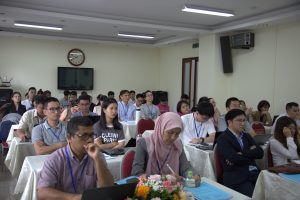
An online meeting was organised in September 2022. The first international conference titled “Surface water quality in Asian large cities: monitoring and management” was organised from 12–14 January 2023 in Hanoi. The second international conference titled “Water environment in large cities in Asia: pollution statement and one health” was organised from 17 – 20 July 2024 at the Institute of Natural Product Chemistry (INPC), Vietnam Academy of Science and Technology (VAST). These meetings and conferences provided an excellent opportunity to enhance scientific collaboration and exchanges.
Challenges and opportunities
The project has enabled close communication and collaboration between scientists from different disciplines in different countries in Asia (Vietnam, Singapore, China, Cambodia, Thailand and the Republic of Korea) and other regions (e.g. France), who directly and indirectly worked with the project network. The present project also provided an ideal opportunity for participants to develop partnerships with institutions inside and outside the Asia-Pacific region that have an interest in global change research related to water quality, especially on EPs, and scientific capacity development being conducted in the region.
As noted, a website is available for this project (http://depscaproject.com). This website is considered a playground and a knowledge-sharing space for researchers who want to exchange their knowledge and data on EPs in East and Southeast Asia.
Furthermore, the project has helped to train a number of young scientists, lecturers, graduate students and undergraduate students on topics related to EPs in water. It has also motivated young scientists and lecturers to learn from experts by seizing opportunities to interact with them.
References
- Dulio, V., van Bavel, B., Brorström-Lundén, E., et al. (2018). Emerging pollutants in the EU: 10 years of NORMAN in support of environmental policies and regulations. Environmental Sciences Europe, 30(5). https://doi.org/10.1186/s12302-018-0135-3
- Pontius, F. W. (2021). Emerging contaminants in water: Detection, treatment, and regulation. Water, 13(11), 1470. https://doi.org/10.3390/w13111470
- Rüegg, J. (2023). Chemical pollution and One Health: From reactivity to proactivity. Uppsala Health Summit 2023.
- Sanganyado, E. (2022). Policies and regulations for emerging pollutants in freshwater: Challenges and opportunities. https://doi.org/10.1016/B978-0-12-822850-0.00007-7
Related content

Predicting total alkalinity in saline water using machine learning: A case study with RapidMiner

Faecal contamination and its relationship with some environmental variables of four urban rivers in inner Hanoi city, Vietnam
