South Asia is a hotspot for heat wave related incidences. Between 1979 and 2017 the extreme combinations of heat and humidity doubled in much of India, Bangladesh and Pakistan. In some parts, summer temperatures are projected to increase by 3°C–6°C by 2100. Around 800 million South Asians live in heat “hotspots” that will face worse heat waves in the future. To minimize heat stress impact on health, work productivity and livelihoods of the economically and socially marginalized population, especially women, there is an urgent need to design and implement gender sensitive Heat Action Plans (HAP) focused on vulnerable groups. However, there is a lack of a focused strategy to build capacities of local administrations to develop HAPs.
The project collaborated with the city municipal corporations of Colombo (Sri Lanka), Rajshahi (Bangladesh) & Surat(India) to develop climate adaptive and gender integrated heat action plans. The project did mapping of urban heat islands in the project cities, conducted field surveys to assess the impact of heat stress on livelihoods, health and productivity, identified specific factors contributing to vulnerability. The detailed framework for gender integrated heat action plans (HAP) was developed. A step wise training module for developing HAP was developed in English which was translated into local languages – Bangla and Sinhalese for capacity building of the local stakeholders. The project engaged with the key decision makers/policy-makers and stakeholders to evolve and disseminate knowledge and build capacity of the stakeholders for designing spatially differentiated and gender sensitive HAPs. The project also supported the project cities in developing the capacity of the city administration, increase awareness and knowledge among policy-makers and communication to the stakeholders.
Related content

Climate adaptive and gender integrated heat wave action plan of Surat City, India
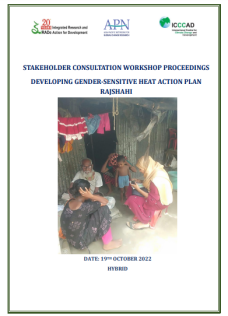
Stakeholder Consultation Workshop (Rajshahi, Bangladesh): Developing gender-sensitive heat action plan
