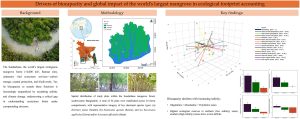
Mangrove forests play a vital role in climate regulation, carbon storage, and biodiversity conservation, yet their capacity to meet ecological demands remains poorly quantified. The Sundarbans, the world’s largest contiguous mangrove ecosystem, faces escalating environmental pressures that threaten its biocapacity—the ability of ecosystems to provide renewable resources and absorb human-generated waste. This study evaluates biocapacity and ecological deficit/reserve at local, national, and global scales by integrating key environmental drivers, including salinity, stand structure, and climate variables. Data were collected from 54 georeferenced plots covering 54 management compartments, and analyses were conducted at plot-level, compartment-level, and broader regional scales. Results reveal significant spatial variability, with the oligohaline zone supporting the largest ecological reserve (1.87 ± 0.164 gha/person), followed by the mesohaline (1.13 ± 0.167 gha/person), whereas polyhaline regions exhibit the lowest reserve (0.48 ± 0.1 gha/person). Globally, polyhaline zones face severe ecological deficits (−1.11 ± 0.1 gha/person), highlighting their vulnerability to environmental stressors. Biocapacity correlates with salinity (r = −0.39), temperature (r = −0.42), precipitation (r = 0.32), and elevation (r = 0.35), while structural attributes such as tree height (r = 0.33) and wood density (r = 0.34) further shape ecosystem capacity. To strengthen environmental management, biocapacity assessments should be integrated into policy and conservation planning frameworks for sustainable resource allocation. As climate change alters temperature and salinity regimes, proactive mitigation strategies, ecosystem-based adaptation, and sustainable management practices are essential for maintaining ecological balance, reducing biodiversity loss, and ensuring the stability of mangrove ecosystem services.
Related content

Contribution of mangrove ecosystem services to local livelihoods in the Indian Sundarbans

Annual mangrove vegetation cover changes (2014–2020) in Indian Sundarbans National Park using Landsat 8 and Google Earth Engine
