22 July 2026, Kobe, Japan — The Asia-Pacific Network for Global Change Research (APN) and the Hyogo Prefectural Government co-hosted the parallel session “SDGs International Forum 2026” at the 18th International Forum for Sustainable Asia and the Pacific (ISAP2026), organised by the Institute for Global Environmental Strategies (IGES).
Held at Lasse Hall in Kobe, Japan, ISAP2026 convened experts and stakeholders from international organisations, governments, businesses and NGOs to exchange perspectives on sustainability challenges. The forum took place in the Kansai region for the first time and featured both in-person and online participation.
The programme opened with remarks from Hirotaka Ishihara, Minister of the Environment, Japan; Shinichi Morimoto, Vice Governor of Hyogo Prefecture; and Kazuhiko Takeuchi, President of IGES. Armida Salsiah Alisjahbana, Under-Secretary-General of the United Nations and Executive Secretary of the United Nations Economic and Social Commission for Asia and the Pacific (ESCAP), then delivered a keynote speech. The programme also featured a panel discussion and parallel sessions with experts from Japan and abroad.
SDGs International Forum 2026
The session, co-hosted by APN and the Hyogo Prefectural Government, attracted 196 participants from Japan and abroad, including 70 onsite and 126 online participants, with simultaneous Japanese and English interpretation provided throughout. Under the theme “Synergistic approaches for climate change action and biodiversity conservation”, the session featured presentations by two experts.
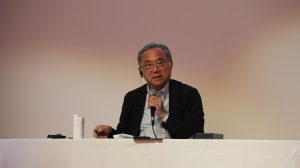
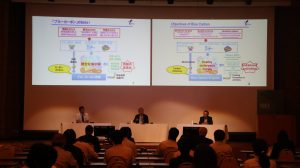
Masato Nobutoki, Invited Professor at the Carbon Neutral Promotion Headquarters, Kobe University, presented “Blue carbon: Reconnecting with the sea and cities, building sustainable communities”. Aidy Mohamed Shawal Bin M. Muslim, Professor and Head of Remote Sensing and Marine Informatics at the Institute of Oceanography and Environment, Universiti Malaysia Terengganu, presented “Enhancing coastal risk reduction science and practice by considering climate, ecosystems and communities in the tropical region”.
Masato Nobutoki presented examples of kelp and seaweed cultivation in Yokohama City and Hyogo Prefecture. These examples showed that blue carbon initiatives can create multifaceted value beyond decarbonisation, including biodiversity conservation and the revitalisation of local economies. He also highlighted the importance of quantitatively evaluating environmental value and establishing mechanisms to channel funding back to implementing organisations.
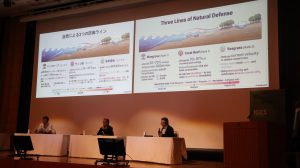
Aidy Mohamed Shawal Bin M. Muslim, who led the APN project, Enhancing coastal risk reduction science and practice by considering climate, ecosystems and communities in the tropical region (CRRP2022-06MY-Muslim), presented examples from tropical coastal areas in Malaysia and Indonesia. These examples showed that ecosystem-based disaster risk reduction (Eco-DRR), using mangroves and coral reefs, can simultaneously reduce disaster risk and conserve biodiversity. He also provided concrete examples of how scientific knowledge can inform policy, including the adoption of a Coastal Vulnerability Index that incorporates social vulnerability into national policy.

Panel discussion
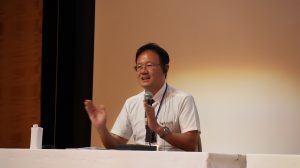
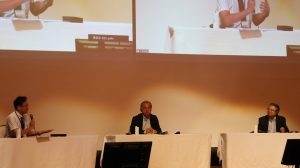
The subsequent discussion, moderated by Toshiyuki Yamasaki, Director of the APN Secretariat, brought together panellists Masato Nobutoki and Aidy Mohamed Shawal Bin M. Muslim. Participants highlighted the need for people who can connect stakeholders across sectors to translate synergies from theory into practice. They also emphasised the importance of mechanisms that enable local communities to participate in decision making and partnerships among diverse stakeholders.
Key messages
The presentations and discussion highlighted several key considerations for translating synergies between climate change action and biodiversity conservation into practice:
- Blue carbon and Eco-DRR, as nature-based solutions, can create synergies between climate change action and biodiversity conservation. Sustaining these initiatives requires evaluating and visualising nature’s multifaceted value, establishing mechanisms to channel funding back to local communities and creating systems that enable local communities to participate proactively.
- Translating synergies from theory into practice requires cross-sectoral leadership, public–private collaboration and partnerships among researchers, governments, local communities, businesses and other stakeholders.
- Scientific knowledge needs to inform policy and local practice. Researchers, governments and local communities therefore need to collaborate and engage in codesign from the early stages.
To watch the forum, please see the recorded video. Presentation materials are available for download.
Related content

Report on the “The climate change and its impacts on pasture and desertification” training workshop in Inner Mongolia, China

Recognizing the role of mangrove forest as a nature-based climate solution: Empirical evidence from Sundarbans mangrove forest of Bangladesh
