30 January 2026, Tamba, Hyogo, Japan – The Asia-Pacific Network for Global Change Research (APN), in collaboration with Hyogo Prefecture, the Tamba Region Environmental Partnership Council, and the Siri-Tan Valley Promotion Council (Wood Valley Project), organised an international symposium titled, Realising Nature Positivity and Regional Circulation: Bridging Global and Local Perspectives.
Held at the Tamba-no-mori Park Hall in Tamba City, Hyogo Prefecture, the symposium featured simultaneous interpretation in English and Japanese. The event drew a total of 502 participants and viewers from Japan and abroad, including 101 in-person participants and 401 online viewers, with catch-up streaming available until 9 February.
Opening Remarks and Policy Overview
The symposium opened with opening remarks from Mr Toshiyuki Yamasaki, Director of the APN Secretariat, who noted the international significance of Nature Positivity and recent trends in Japan. He introduced the achievements of APN as an intergovernmental network of 22 countries in the Asia-Pacific region, emphasising its role in bridging science and policy through collaborative research and scientific capacity development. He expressed high expectations that the symposium would serve as a catalyst for new partnerships linking global goals with local practices.
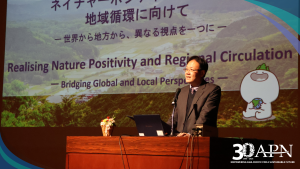
Mr Hiroyuki Kasutani, Executive Director General of the Tamba District Administration Office, Hyogo Prefectural Government, introduced the unique natural and cultural heritage of the Tamba region. He noted that the philosophy of “Tamba-no-mori” (Tamba Forest) aligns with nature-positive concepts and looked forward to the symposium as a step toward building a future that connects the world with the local community.
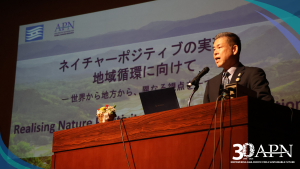
Mr Teruyuki Ainura, Director, Natural Environment & Wildlife Management Division, Environmental Management Department, Hyogo Prefectural Government, explained the Biodiversity Hyogo Strategy, which was revised in March 2025. He stressed the importance of the 30×30 target (protecting 30% of land and marine areas by 2030), measures to address invasive species and collaborative conservation efforts involving government, local residents and various organisations.
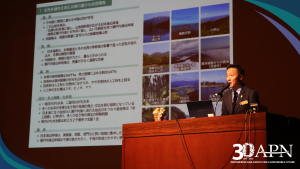
Special Lecture
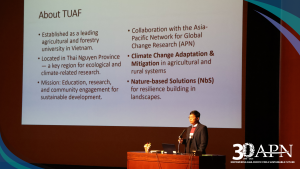
Prof. Ho Ngoc Son, Thai Nguyen University of Agriculture and Forestry, Vietnam, delivered the special lecture, From Local Roots to Global Goals: Advancing Nature Positivity through Circular and Community-based Landscapes in Vietnam. He explained that nature positivity is a concept aimed at restoring ecosystems, enhancing biodiversity and regenerating landscapes.
To ensure that global goals take root locally, he emphasised the importance of circular systems, community leadership and thinking on a landscape scale, in which forests, farms, water and settlements are interconnected. He also underscored the need for integrating Indigenous and Local Knowledge (ILK) systems with scientific expertise.
Furthermore, he introduced Nature-based Solutions (NbS) as a practical methodology and shared case studies of circular agriculture in ethnic minority areas of northern Vietnam, including vermiculture, biochar and agroforestry.
Keynote Lecture
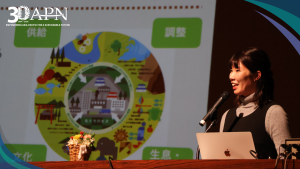
Associate Professor Mieko Kiyono, Graduate School of Human Development and Environment, Kobe University, delivered a keynote titled, Realising Nature Positivity in the Tamba Region: Challenges and Prospects.
She pointed out that while the Tamba region possesses rich ecosystem services, it simultaneously faces complex challenges such as wildlife damage and a shortage of human resources to lead community activities. She defined nature positivity as a shift from “protection” to “enhancement”, halting nature loss and putting it on a path to recovery. She stated that the key to achieving the 30×30 target lies in expanding the registration of Other Effective Area-based Conservation Measures, specifically targeting lands managed by the private sector and other non-government actors. Regarding monitoring, which is indispensable to this progress, she presented a hopeful prospect: The existing network of wildlife surveys conducted by local community groups, schools and research institutions in the Tamba region will provide a strong foundation of human resources.
Case Studies in Local Innovation
The symposium featured two case studies that highlighted regional efforts:
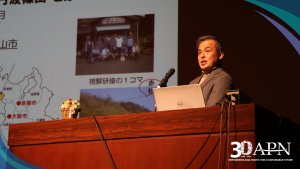
- Mr Ryuji Takahashi, Chairperson of NPO Biomass Tamba-Sasayama, discussed The Past and Future of Regional Cycles: Inheriting Wisdom and Shaping What Comes Next. He positioned Satoyama-based living and ancestral wisdom as the foundations of nature positivity. He introduced the Timber Station Project, which supports the use of thinned wood by residents and revitalises the local economy through payments in local currency. He also highlighted initiatives such as wood pellet production to promote the cascade use of timber, Forest-Welfare Collaboration, and wood education to foster human resources for a low-carbon society.
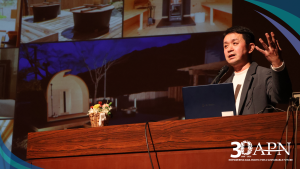
- Mr Tatsuo Adachi, Representative of FOREST GROUP, presented Management that Transforms Forests and an Abandoned School into Resources: Implementing a Creating Shared Value (CSV) Model that Mobilises Local Communities. He noted the distinct disparity between global deforestation trends and Japan’s expanding yet underutilised forest stock. He stressed that “using local timber is the essential way to protect our forests,” framing timber utilisation as a vital act of conservation tailored to the specific forestry needs of Japan. Furthermore, he proposed a new model combining undervalued resources, such as timber and abandoned schools. By showcasing “FOREST DOOR,” a project that repurposes the former Kagura Elementary School, he illustrated the potential of CSV to generate both social and economic benefits.
Panel Discussion
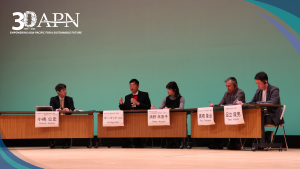
The panel discussion was moderated by Dr Satoshi Kojima, Acting Director of the Kansai Research Centre at the Institute for Global Environmental Strategies. The panellists shared the following key perspectives:
- Prof. Ho emphasised the importance of flexibly adapting global frameworks to local contexts and co-designing solutions with communities.
- Assoc. Prof. Kiyono highlighted the need for technological innovations to visualise conservation outcomes and stressed the importance of respecting local names, traditions and cultural knowledge in biodiversity conservation.
- Mr Takahashi underscored the need to develop human resources capable of passing on traditional ecological knowledge to future generations.
- Mr Adachi emphasised that increasing the use of local timber can improve forest management, restore overgrown forests and generate economic benefits that strengthen regional circularity.
The session provided valuable insights into how international environmental targets can be translated into concrete local actions and sustained through community engagement and cross-sector collaboration.
The Nature Positive Declaration
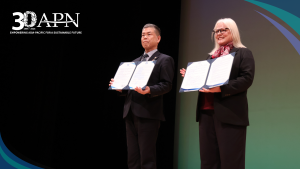
The symposium concluded with the announcement of a Nature Positive Declaration delivered by Mr Hiroyuki Kasutani, Executive Director General of the Tamba District Administration Office, Hyogo Prefectural Government, and Dr Linda Anne Stevenson, Programme Director of the APN Secretariat. Both leaders expressed their firm commitment to achieving a sustainable future.
APN remains committed to collaborating with Hyogo Prefecture, research institutions and various stakeholders to further public understanding of global environmental issues and promote impactful regional actions.
To watch the forum, please check the videos below:
Programme flyer and presentation materials are available for download.