The Vietnamese Mekong Delta (VMD) agricultural system has shifted from landrace varieties and floating rice in the upper delta to high-yield rice varieties, driven by historical efforts to reclaim and cultivate acid sulphate soils. Following the “Đổi Mới” reforms of 1986, large-scale land reclamation took place to meet growing food demand. High-yield rice varieties introduced during the Green Revolution replaced most landrace and floating rice, which are less tolerant of deep flooding and poorly adapted to acid sulfate soils. This shift has been supported by government initiatives, enabling Vietnam to achieve food self-sufficiency and become one of the world’s leading rice exporters.
A negative effect of this transformation is that soils have become increasingly degraded, polluted and nutrient-depleted, as floodwater and sediments can no longer reach the fields. This has resulted in severe soil degradation and the accumulation of toxins. The VMD is also one of the regions most heavily impacted by climate change and sea-level rise. The delta’s low elevation of ~0.82 m above sea level (Minderhoud et al., 2019), combined with rapid land subsidence averaging 1.1 cm/year (Minderhoud et al., 2017), makes it increasingly susceptible to flooding, salinity intrusion (Eslami et al., 2019) and the risk that large portions of the delta will fall below sea level as global sea levels rise. For instance, up to 75% of the delta could be submerged under one metre of sea-level rise (Minderhoud et al., 2019), while a sea-level rise of 20–45 cm could increase flood levels by 11.9–32.2 cm in flood seasons, affecting 1–4.7 million people (Wassmann et al., 2004). The loss of natural water storage capacity in the upper VMD, coupled with upstream water extraction from the Mekong River, has further reduced freshwater availability, leading to declines in wild fish populations, reduced biodiversity and increased salinity intrusion.
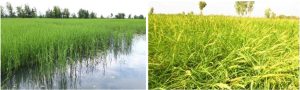
Therefore, the project, Nature-based solutions for food security under climate change effects for sustainable development in the Mekong Delta (CRRP2023-04MY-Doan Van), promotes the use of floating rice as a nature-based solution (Figure 1). This approach replaces the third crop in the triple cropping system (i.e. flood-season crop), with the aim of maintaining farmers’ income while improving soil properties, restoring ecosystems and enhancing climate change resilience in the region.
Key Findings
In the high, close-dyke system, where farmers cultivate three high-yielding rice crops yearly, opening sluice gates allows sediment to enter and deposit in fields, thereby increasing natural fertilisation. Results from a two-dimensional hydrodynamic model of a high, close-dyke paddy field in the Long Xuyen Quadrangle indicate that, if all sluice gates are fully opened during the peak period of the 2023 flood season, the sediment deposited within the field reaches 24.179 m3. In contrast, no sediment can come into the field if all sluice gates are closed to support the triple rice crop system.
In 2023, when the floodwater levels were higher, the amount of sediment collected in the floating rice field in the Long Xuyen Quadrangle varied by location: 4.36 t/ha at sites near the sediment source (i.e. irrigation channels), 2.98 t/ha at intermediate sites and 2.06 t/ha at distant sites. In contrast, in 2024, when floodwater levels were lower, sediment accumulation decreased markedly to 2.26 t/ha, 1.38 t/ha and 0.75 t/ha, respectively. T-test results indicated a statistically significant difference in the sediment accumulation between 2023 and 2024. These findings suggest that sediment deposition in floating rice fields is strongly influenced by annual hydrological conditions, particularly floodwater levels. Moreover, the distribution of sediment across the field depends on its proximity to the sediment source; the farther the field is from the sediment source, the less sediment it receives.
Significant differences were observed in nutrient concentrations between 2023 and 2024 in the floating rice field in Long Xuyen Quadrangle, reflecting variations in the amount of sediment carried by annual floods. In 2024, both the total sediment load and mineral contents markedly decreased compared with 2023. The mineral composition of the soil depends mainly on the annual sediment deposited, which in turn is determined by the flood scale and intensity. Among the analysed components, organic carbon (OM) exhibited the highest concentration (the mean values of all sediment samples in the floating rice were 681.8 kg/ha in 2023 and 339.8 kg/ha in 2024), followed by total nitrogen (N) (mean values of 271.7 kg/ha in 2023 and 164.8 kg/ha in 2024), total ammonium (NH₄⁺) (66.4 kg/ha in 2023 and 40.3 kg/ha in 2024), and total phosphorus (P) (7.5 kg/ha in 2023 and 3.8 kg/ha in 2024). Although concentrations vary among components, all these minerals play important roles, to varying degrees, in supplying nutrients to the soil and floating rice crops.
Nutrient-rich sediment from floods supports the growth of floating rice, improving both yield and grain quality. In the floating rice of the Long Xuyen Quadrangle, minerals directly associated with yield components and total floating rice yield included potassium (K), zinc (Zn), sodium (Na) and boron (B). Both K and B had a significant (p < 0.05) direct effect on the 1,000-grain weight, with correlation coefficients of 0.71 (strong) and 0.64 (moderate), respectively. Zn showed significant correlations with the total number of grains per panicle (r = 0.69, moderate), number of filled grains (r = 0.70, strong), and floating rice yield (r = 0.74, strong). Na had a significant (p < 0.05) correlation only with the number of panicles per square metre, which was considered strong (r = 0.73).
Additionally, farmers practising floating rice cultivation saw higher profits than those using high-yield rice systems, due to lower input costs. The intensive high-yield rice system incurred an average annual cost of 71.1 million VND/ha, including expenses for land preparation, seeds, fertilisers, pesticides, labour and harvesting services. This cost was 16.8 million VND/ha higher than that of the floating rice–cassava system (53.3 million VND/ha), and the difference was statistically significant at the 5% level (t-test). This is because cassava can soften soil and increase natural soil fertility, reducing costs for land preparation and the application of inorganic fertiliser. On the other hand, the high-yield rice system achieved an average revenue of 118.1 million VND/ha/year, which was 5.3 million VND/ha higher than the floating rice–cassava system (112.8 million VND/ha/year). However, this difference was not statistically significant at the 5% level. As a result, the average profit of the high-yield rice system was 47.0 million VND/ha/year, while that of the floating rice–cassava system reached 58.3 million VND/ha/year. This indicates that the floating rice–cassava model generated a profit of 11.5 million VND/ha/year higher than the intensive rice system.
Recommendations
Based on the study findings, the following recommendations are proposed:
- Promote flood-friendly dyke systems to allow sediment and water flow into rice fields.
- Optimise operations of sluice gates under dyke systems to maximise sedimentation in the rice fields and replenish soil properties.
- Support the conservation and development of landrace rice as floating rice varieties and complementary crops, such as cassava, to enhance farmers’ livelihoods and ecological sustainability.
- Develop policies at various levels (local, provincial and national) to integrate sediment management and floodwater release into agricultural practices to enhance climate resilience.
- Continue research on the benefits of sediment for improving soil fertility and rice yields, and on nature-based solution models for rice systems in the upper VMD.
Acknowledgements
We would like to thank the Asia-Pacific Network for Global Change Research under project reference number CRRP2023-04MY-Doan Van, as well as all collaborators and stakeholders who contributed to the research.
References
- Eslami, S., Hoekstra, P., Nguyen Trung, N., Ahmed Kantoush, S., Van Binh, D., Duc Dung, D., Tran Quang, T. and van der Vegt, M., 2019. Tidal amplification and salt intrusion in the Mekong Delta driven by anthropogenic sediment starvation. Scientific Reports, 9(1): 18746.
- Minderhoud, P.S.J., Coumou, L., Erkens, G., Middelkoop, H. and Stouthamer, E., 2019. Mekong delta much lower than previously assumed in sea-level rise impact assessments. Nature Communications, 10(1): 3847.
- Minderhoud, P.S.J., Erkens, G., Pham, V.H., Bui, V.T., Erban, L., Kooi, H. and Stouthamer, E., 2017. Impacts of 25 years of groundwater extraction on subsidence in the Mekong delta, Vietnam. Environmental Research Letters, 12(6): 064006.
- Wassmann, R., Hien, N.X., Hoanh, C.T. and Tuong, T.P., 2004. Sea Level Rise Affecting the Vietnamese Mekong Delta: Water Elevation in the Flood Season and Implications for Rice Production. Climatic Change, 66(1): 89-107.


