28 September 2025, Kobe, Japan – The Asia-Pacific Network for Global Change Research (APN), in collaboration with Hyogo Prefecture and the Institute for Global Environmental Strategies (IGES), held the “Satoyama International Forum” at the Hyogo-no-tsu Museum. This forum was organised with support from the International Forum for Sustainable Asia and the Pacific (ISAP) as a collaborating partner.
The Satoyama International Forum aimed to reaffirm the historical and cultural significance of Satoyama landscapes and to provide a platform for exploring ways to live in harmony with nature while advancing a sustainable society. A total of 102 participants joined, including practitioners, members of the general public from Japan and abroad, government officials and researchers.
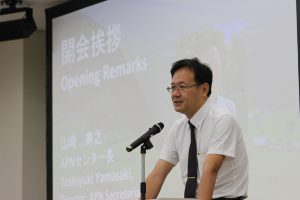
APN Director Toshiyuki Yamasaki opened the forum by referring to the Sixth Basic Environment Plan, announced by the Ministry of the Environment in May 2024. He explained that the plan places top priority on maintaining, restoring and enhancing natural capital, and emphasised the need for collaboration among residents, government authorities and businesses to address local issues by making effective use of regional resources and characteristics. He also highlighted the Regional Circulating and Ecological Sphere (Regional-CES) as a key framework for building a sustainable society.
He went on to introduce the initiative in Hyogo Prefecture known as the “Hokusetsu Satoyama Regional-CES”, and noted that APN has been using this region as a platform to disseminate internationally the significance of Satoyama. He mentioned that the experiences from 2014 to 2018 — when local residents, government and overseas researchers came together in places such as the Kurokawa region, Takarazuka Nishitani Forest Park and Itami-shi Koya Pond Park to discuss what sustainable Satoyama ought to be — have led up to this “Satoyama International Forum”.
In closing, he expressed his hope that “through today’s forum, we will share insights from both Japan and abroad and use this as an impetus to think about ways of circulation and symbiosis rooted in local communities.”
Session 1: Keynote Lecture
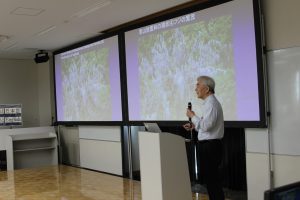
Professor Emeritus Tamotsu Hattori of the University of Hyogo delivered a lecture titled “Satoyama Forest in Kurokawa, Kawanishi City, Hyogo Prefecture, Sustained by the Tea Ceremony Culture.” Drawing on his extensive research, Professor Hattori explained the formation of Japan’s Satoyama forests and their relationship with human activities over time.
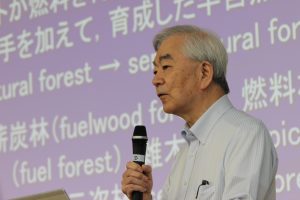
At the beginning of his lecture, he defined a Satoyama forest as a “semi-natural forest managed and cultivated by humans from a natural forest for fuel.” He then explained the characteristics and geographical distribution of lucidophyllous forests—the original vegetation type that served as the basis for Satoyama forests—from a geographical perspective. Using examples of lucidophyllous forests preserved in shrine and temple groves across Japan, he emphasised that “the culture of preserving forests within religious sites is unique to Japan and serves as a living memory of ancient forests.”
Professor Hattori also described the historical background of Satoyama formation, explaining that the spread of sedentary life and rice cultivation during the Yayoi period created a demand for fuel. This led to the cutting of lucidophyllous forests and the establishment of Satoyama forests for the production of firewood, brushwood and charcoal. He stressed that “the Satoyama has provided fuel to the Japanese people for 2,000 years through repeated regeneration by sprouting from stumps.”
Referring to the famous folktale Momotaro, he explained that the line “The old man went to the mountain to cut brushwood” does not simply describe gathering brushwood, but rather represents an integrated activity of forest management and fuel acquisition—a sustainable, cyclical practice. This, he noted, reflects the traditional wisdom embedded in folktales.
However, Professor Hattori pointed out the current deterioration of Satoyama forests caused by the decline in fuel use. Many forests have been abandoned, leading to the proliferation of climbers and dwarf bamboo, as well as damage caused by deer.
He then introduced Kurokawa in Kawanishi City, Hyogo Prefecture, as a rare example where the traditional Satoyama landscape is still being maintained. In this area, pollarded Kunugi (Quercus acutissima) forests are cyclically managed for the production of high-quality charcoal known as Hitokura charcoal and Ikeda charcoal, which are essential for the Japanese tea ceremony. Traditional techniques of felling and regeneration are still practised today, and the forests are used for community learning and experiential activities.
In closing, Professor Hattori quoted a poem from the Manyoshu (Vol. 10, Poem 2177):
“In spring, plants sprout in fresh green; in summer, deep green leaves flourish; and in autumn, the mountains are coloured with reddish brown leaves like a patchwork.”
He explained that this verse is often interpreted as describing autumn foliage, but its true meaning lies elsewhere: “The mountains appear patchy because the felling years differ—first year, second year, third year—creating a landscape of patchwork produced by felling rotation.”
He concluded, “The authentic Satoyama patchwork landscape described in the Manyoshu remains only in Kurokawa today.”
Session 2: Introduction of Overseas Case Study
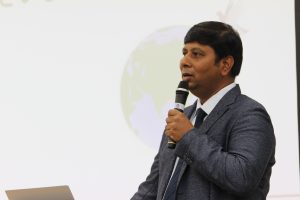
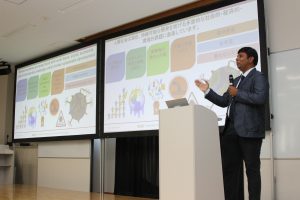
In the session on overseas case studies, Dr Bijon Kumer Mitra, Research Director at the Integrated Sustainability Center, IGES, delivered a lecture titled “Localising Global Agendas: Regional-CES based Approach for Synergistic Local Actions towards a Carbon Neutral, Resilient Society.”
Dr Mitra introduced the concept of Regional Circulating and Ecological Sphere (Regional-CES) as a framework for achieving global sustainability goals—such as the SDGs, the Paris Agreement and the Nature Positive by 2030 initiative—at the local level. He emphasised that “to address the complex challenges driven by human activities—such as demographic change, urbanisation, climate change and overexploitation of resources—localised actions are indispensable.” He further noted that “it is not sufficient to set ambitious goals and policies; the key is to translate global commitments into local implementation.” Dr Mitra highlighted the need for integrated actions that can simultaneously address multiple challenges rather than isolated, issue-specific measures.
He described Regional-CES as an integrated policy approach that leverages unique urban–rural linkages within a defined area to build a self-reliant, decentralised, and sustainable society, achieving decarbonisation, efficient resource circulation, harmony with nature, economic revitalisation, and community well-being simultaneously. By complementing rural areas rich in natural resources with the technology, finance and expertise of urban areas, he explained that regions can achieve both environmental restoration and economic revitalisation.
Citing examples from Japan, Dr Mitra introduced several Regional-CES practices, including the renewable energy partnership of Yokohama City, the food waste recycling project in Kitakyushu City and Kanagawa Prefecture’s Water Environment Conservation Program. He then presented the activities of the CES–Asia Consortium, established in 2021 to promote the localisation of the Regional-CES model across ten countries in South and Southeast Asia. Through this consortium, local governments and research institutions collaborate to co-develop Regional-CES models tailored to local needs and resources, advancing their integration into national policies and community practices.
He stressed, “What truly matters is that the solutions we propose align with the needs of local communities.” The consortium is working to explore synergistic local actions and strengthen regional cooperation, with examples including:
- the introduction of a water resource conservation tax for rainwater harvesting in Nagpur, India;
- urban–rural collaboration for food and water security in Udon Thani, Thailand; and
- solar sharing initiatives that combine agriculture with renewable energy generation in Bangladesh.
In his lecture, Dr Mitra also discussed the relationship between Regional-CES and the Satoyama concept, stating that “both concepts promote circular resource use and regional sustainability based on local resources and activities.” He noted, however, that while Satoyama focuses primarily on community-based initiatives, Regional-CES encompasses both urban and rural dimensions. He emphasised the crucial role of the private sector in bridging the gap between policy and implementation, pointing out that private sector engagement not only provides necessary financial support but also opens up new business opportunities in fields such as clean energy, green infrastructure and sustainable agriculture.
In conclusion, Dr Mitra noted that numerous policy challenges persist for successful application of the Regional-CES, including institutional, governance and financial issues. He emphasised that enabling solutions to advance the Regional-CES concept must be driven by co-development actions, community empowerment and active engagement of the private sector.”
Programme Flyers:
Presentation Materials:
Professor Emeritus Hattori’s Presentation Materials (Japanese)
Professor Emeritus Hattori’s Presentation Materials (English)
Dr Mitra’s Presentation Materials (Japanese)
Dr Mitra’s Presentation Materials (English)

