29 March 2026, Bangkok, Thailand – APN participated in the Asia and the South-West Pacific Regional Outreach in support of the Intergovernmental Panel on Climate Change (IPCC) processes. The outreach event brought together National Focal points and representatives of academia and research institutions from across the region to increase awareness about the IPCC processes and enhance their contribution to the seventh assessment cycle.
APN Secretariat Director Toshiyuki Yamasaki participated in the afternoon panel discussion, Knowledge brokerage for policy and practice (Linking to policymakers and practitioners), where he was joined by Dr Albert Salamanca, Senior Research Fellow (Stockholm Environment Institute); Associate Professor Tavida Kamolvej, Deputy Governor (Bangkok Metropolitan Administration); and Dr Senaka Basanaye, Climate Services Lead (Asian Disaster Preparedness Center).
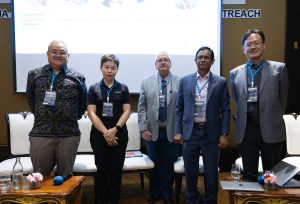
During the panel, Mr Yamasaki shared APN’s long-standing experience in connecting science, policy and communities across the Asia–Pacific region. He emphasised that the effective application of IPCC findings requires translating complex scientific assessments into formats that policymakers can readily use. This is reflected in the work of APN over the past 30 years, during which it has built a regional network that supports knowledge brokerage and enables scientific insights to inform decision making.
The discussion also highlighted the importance of co-design, noting that when policymakers and scientists jointly define research questions from the outset, IPCC findings become more actionable. APN supports this approach through its Collaborative Regional Research and Scientific Capacity Development programmes, where activities such as workshops, training programmes and forums provide effective avenues to help countries interpret knowledge within their own context.
Addressing challenges in localising IPCC findings, Mr Yamasaki identified persistent data gaps and inconsistencies across countries, as well as other barriers such as differences in language, misaligned timelines and limited opportunities for dialogue between scientists and policymakers. Furthermore, while adaptation requires long-term commitment, he noted that short-term funding cycles often hinder sustained action. Limited technical capacity, particularly in small island developing states and least developed countries, also remains a major barrier to applying IPCC findings at the local level.
To overcome these challenges, he stressed the need to strengthen the role of knowledge brokers who connect scientists, policymakers and communities. He also underscored the value of locally driven co-production of knowledge, along with long-term and predictable funding mechanisms and standardised data platforms that can be shared across borders. Continued investment in capacity development through training, fellowships and exchanges is equally essential.
He then introduced several APN projects as examples of community-led climate action in the region, including mangrove restoration and community-based adaptation planning in Southeast Asia, climate-smart agriculture in rural South Asia, community-led vulnerability assessments in Pacific Island countries, and the adoption of heat action plans in urban areas. These examples demonstrate how these approaches are applied in practice, and how integrating scientific knowledge with local experience fosters strong community ownership of climate action.
He concluded his remarks by stating, “The real challenge is not accessing IPCC knowledge, but translating it into policy that is practical, context-specific and sustainable over time, and that can be applied more broadly across different contexts. This ultimately depends on continuous dialogue, long-term investment in capacity and strong regional platforms such as APN.”
Through this panel, the importance of knowledge brokerage in bridging science, policy and communities was reaffirmed, along with the critical role APN continues to play in supporting this work across the region.
Building on these discussions, the outreach event emphasised the need to strengthen science policy linkages, improve communication of IPCC findings into accessible policy language, and expand regional outreach and capacity building to increase participation from Asia and the South-West Pacific. It also called for establishing shared data platforms, enhancing the use of IPCC frameworks in national policymaking, and ensuring more inclusive, representative engagement across countries and stakeholder groups.
For more information about the outreach event, visit the activity page.
Photo source: IPCC
Related content

Climate Change × Disaster Reduction: Thinking about sustainable city planning and communities

Fostering the Regional Circulating and Ecological Sphere Approach to Translate Global Goals into Local Actions – Lessons from National Scoping Workshops in ASEAN Countries
