
Strengthening the capacity of officials on Integrated Flood Management Plans into provincial disaster prevention plans in the coastal provinces of Central Vietnam
Keywords
Disaster Prevention Plan · IMFP · Strengthening the Capacity · Vietnam
HIGHLIGHTS
- The capacity of localities in integrated flood management is relatively low in the target provinces.
- The capacity building training workshops were favourably received by participants.
- There is an ongoing need to strengthen the capacity of local agencies in disaster prevention and risk management.
1. INTRODUCTION
Integrated flood management (IFMP) is an integrated process of land and water resource management aimed at maximising the advantages of flood-prone delta regions and reducing the damage caused by floods. This involves a watershed-based and multidisciplinary approach, community participation and support from flood management mechanisms and policies (Philippe Gourbesville, 2020; World Meteorological Organization, Global Water Partnership, 2009). This makes the creation of IFMP fairly challenging and necessitates that local governments have in-depth expertise in integrated flood management, as well as in GIS, flood mapping, risk assessment, and proposing mitigation measures. The integrated flood management approach is considered a method of flood management that produces high effectiveness in reducing flood risks while addressing the limitations of traditional flood management methods. This strategy aims to address flood difficulties in a specific location without exacerbating the flood situation in nearby areas, taking into account the comprehensive system of water resources and disaster prevention at both local and regional levels. Currently, IFMP has been applied extensively in many river basins in the world, such as the Belize River basin in Belize – a Central American country (Green Climate Fund, 2023), Niger-South River basin in Nigeria (Iguniwari Ekeu-Wei, 2018), Kagera Basin covers portions of the four countries of Burundi, Rwanda, Tanzania and Uganda (Munyaneza et al., 2011), Ciujung, Cidurian and Cidanau Rivers in Indonesia (Asian Development Bank, 2017), and Chi River basin in Thailand (Kittiwet Kuntiyawichai, 2012).
According to statistics in 2021, more than ten severe floods occurred across the three provinces of Quang Nam, Quang Ngai, and Binh Dinh, leaving seven people dead and fifteen injured. The disasters inundated 38,564 houses, damaged or destroyed 358,037 hectares of rice and crops, collapsed 1,400 metres of embankments, and degraded 1,200 metres of dikes, with total estimated losses amounting to several trillions of VND (Steering Committee for Disaster Prevention and Search and Rescue of Binh Dinh, Quang Nam, Quang Ngai provinces, 2022).
Disaster risk management in Vietnam has become an increasingly important issue that the government consistently prioritises. Vietnam has implemented numerous policies and a system for managing disaster risks to prevent and lessen the harm caused by natural disasters. The Vietnamese disaster risk management system is crucial in building capacity to respond to increasing exposure to hazards, vulnerability and extreme climate events, as well as coordinating community actions for disaster risk reduction and climate change adaptation (IMHEN, UNDP, 2015). Recently, Vietnam has adopted the “4 on-the-spot” approach, which combines the application of science and technology in forecasting and monitoring, along with risk assessment activities, to develop response and recovery plans following disasters. Numerous options have been proposed. However, the traditional management response to a severe flood was typically an ad hoc reaction. This quick response considered both the problem and its solution to be self-evident, without considering the consequences for upstream and downstream flood risks. Therefore, flood management strategies have primarily focused on reducing flooding and minimising the likelihood of flood damage. Existing flood management has employed a combination of structural and non-structural interventions, as well as physical and institutional measures. These actions have occurred before, during, and following flooding and have frequently overlapped. Therefore, there is a need for a different approach (Quynh & Thanh, 2016; World Meteorological Organization, Global Water Partnership, 2009).
In Vietnam, IFMP has been applied in several river basins, including Vu Gia–Thu Bon, Kon–Ha Thanh, Gianh–Nhat Le, Huong, Ba, Cai Ninh Hoa, and Cai Nha Trang. Recognising the advantages and lessons learned from these initiatives, on June 17, 2020, the government issued Law No. 60/2020/QH14, which amended and supplemented several articles of the Law on Natural Disaster Prevention and Control and the Law on Dikes, emphasising the role of IFMP in river basin flood management. The development of IFMP is deemed both essential and consistent with existing legislation, while also proposing comprehensive measures aligned with the long-term development planning of localities. However, most localities have not received formal training in integrated flood management, and only a few localities are familiar with this concept. The implementation of these manuals remains limited due to officials’ limited understanding of IFMP. This project aims to enhance the capacity of officials at all levels in developing/updating the IFMP, as well as integrating it into provincial disaster prevention plans. By that, communities can actively create their own flood and related hazard prevention plans. The project will be implemented in three central coastal provinces, Binh Dinh, Quang Ngai, and Quang Nam, which regularly suffer heavy damage from floods. This article outlines the topics of training workshops in three target provinces, the novelties of the training workshops, participant outputs, and participant evaluations of the training workshops. The suggestions for future activities to enhance the capacity of localities in Vietnam will be proposed.
2. METHODOLOGY
The IFMP was developed based on the consideration of a river basin as a distinct dynamic system. Land and water resources interact within the basin; any changes could have a negative or positive impact on other elements. To prepare for the training session, the IFMP manual was created and utilised as training material. The manual is based on the concept of IFMP and is adapted to the real situation in Vietnam. Thus, the project’s capacity development was accompanied by different approaches.
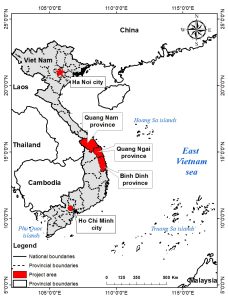
Prior to delivering the training workshops, field surveys were conducted in three project provinces (Figure 1). The purposes of these field surveys were to collect relevant documents on flood management and disaster risk reduction, assess the status of IFMP development at the local level, and identify challenges in IFMP development in each province. Before conducting the field survey, the experts carried out a desk study to review existing documents related to natural conditions, the flood situation in the three project provinces, as well as national and international materials on IFMP. Based on this review, a list of documents and information that need to be collected directly in the three project provinces to supplement missing information was developed. Subsequently, field surveys were conducted with two main components: collecting local documents and conducting in-depth interviews with relevant departments and agencies to assess the status and challenges in developing IFMP. The collected information was analysed in the following steps: (1) grouping similar contents by topics, (2) comparing perspectives among local officials to identify commonalities and differences, and (3) synthesising these into generalised conclusions. The analysis yielded three major findings. First, there was limited awareness of integrated flood management and insufficient capacity to assess flood risk. This was despite the fact that most localities acknowledged the impacts of flooding and the critical need for an effective flood management plan. Second, a significant gap was observed between national strategies and local implementation capacity. For instance, an IFMP is mandated as part of disaster prevention and control under Law No. 60/2020/QH14, as well as under the National Strategy for Natural Disaster Prevention and Control to 2030, with a vision to 2050 (Decision No. 379/QD-TTg, March 17, 2021). However, the concept of integrated flood management was only mentioned but not defined or specified in terms of the content to be implemented. Therefore, the capacity to carry out at the local level was inadequate. (3) The final finding is that insufficient coordination exists between local departments and agencies, despite the significance of this coordination in creating IFMP. However, departments such as the Department of Planning and Investment, the Department of Natural Resources and Environment, and the Department of Finance have a limited understanding of integrated flood management, which results in their responsibilities not being fully understood.
Prior to the training sessions, the consulting unit contacted, discussed, and reached an agreement with the person assigned by the local agency to coordinate project implementation, including training needs, content, materials, and expected participants. Training materials included the IFMP development manual, the manual for integrating the IFMP into disaster prevention and control plans, presentation slides, and discussion topics. Subsequently, the provincial disaster management department issued invitations to participants and circulated the training documents. The training participants included 82 representatives from local departments and agencies, such as: the Provincial Steering Committee for Disaster Prevention and Search and Rescue, Department of Agriculture and Rural Development, Department of Natural Resources and Environment, Department of Transportation, Department of Finance, Department of Construction, the Provincial Hydro-Meteorological Station, Military Command, and District/Commune Steering Committees for Disaster Prevention and Search and Rescue. The participants were primarily between 30 and 50 years old, with 73% male and 27% female. They are key localities involved in disaster prevention and search and rescue at the local level. The training session was structured to begin with an overview of the local flood situation and the urgency of reducing flood-related risks and damages, followed by an introduction to the concept of IFMP, guidance for participants on developing an IFMP for their locality, and finally instructions on integrating IFMP into the local disaster prevention and control plan. The experts served as trainers who employed diverse and flexible learner-centred teaching methods, such as presentations and group discussions. Trainers played the role of facilitators, leading the discussions, providing feedback and synthesising conclusions on each issue. Additionally, the Representative Office of the Viet Nam Disaster and Dyke Management Authority in the Central and Central Highlands Regions contributed by delivering presentations, engaging in discussions, and clarifying local officials’ questions related to national regulations on integrated flood management.
The pre-training and post-training interview questionnaires were developed to assess the effectiveness of the training in enhancing the capacity of the participants. The questionnaires consisted of closed-ended questions, in which participants selected from predefined options. The evaluation focuses on the following contents: Trainees’ desires and expectations before attending the training; Trainees’ understanding of IFMP, integrating IFMP into provincial disaster prevention plans; Difficulties encountered during the implementation according to the manuals; The suitability of the manuals for local implementation; The need for further study related to flood risk. Participants completed the questionnaires immediately before and after the training sessions. At the end of the training session, all questionnaires were collected, and the experts conducted statistical analyses to evaluate changes, improvements, and the extent of knowledge acquisition by the trainees.
During the process of developing the guidelines and preparing training materials, about ten key experts were involved in the consultation, including experts from the consultant, the Head of the Representative Office of the Viet Nam Disaster and Dyke Management Authority in the Central and Central Highlands Regions and local officials who are directly responsible for disaster prevention and control in the three project provinces. The project activities were reviewed by experts who had participated in the development of provincial disaster prevention plans associated with IFMP in many river basins, a task the consultant had previously undertaken. These experts’ broad perspectives and deep experience ensure the success of the project. Based on their knowledge, they have provided initial insights into the advantages and challenges, thereby offering interregional and interdisciplinary observations and reducing project implementation time. The consultation was conducted through both in-person and online discussions.
3. RESULTS AND DISCUSSION
The aim of the training workshops was generally to improve the ability of provincial authorities/organisations and disaster prevention agencies in creating and incorporating IFMP into provincial disaster prevention plans, as well as to encourage interprovincial cooperation in developing IFMP for interprovincial basins and intra-provincial cooperation between various sectors. Based on the former manual of IFMP issued in 2016 (Department of Water Resources, 2016) and the evaluation and review process for the actual implementation of the IFMP at the local level and in the three project provinces, the consultant has updated the manual of IFMP and designed training workshop documents.
3.1. IFMP training workshop
The training workshop was conducted over 2 days in each province. It was designed with two main contents: (i) sharing the knowledge base of IFMP and how to develop IFMP, and (ii) instructions for integrating IFMP into the provincial disaster management plan.
The first section provides a basic overview of the definition of IFMP, the differences between traditional flood management and IFMP, and the steps involved in creating/updating an IFMP (Figure 2).
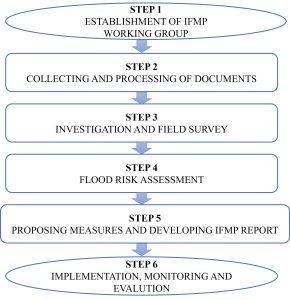
IFMP is developed according to a multi-step process. First, an IFMP working group is established, with the participation of relevant departments, agencies, and units, to ensure intersectoral and effective coordination. Next, the working group reviews the existing legal documents, plans, programmes, projects and other documents, and assesses the challenges and limitations of past flood management efforts. Field surveys are then conducted to collect data on hydrometeorology, topography, infrastructure, and current risk conditions, which serve as the basis for modelling, assessment and identification of flood-risk areas. Based on this data, a risk analysis is conducted using either qualitative or quantitative methods, and hazard maps and flood risk maps are created. Different scenarios (such as climate change, reservoir operation, and urban development) are considered to propose structural and non-structural solutions. The results are compiled into an IFMP that is appropriate to local conditions and aligned with sustainable development objectives. Finally, the important step is implementation, monitoring and periodic evaluation at multiple levels (outputs, results, impacts), in order to promptly adjust the plan, optimise benefits and minimise damage caused by floods.
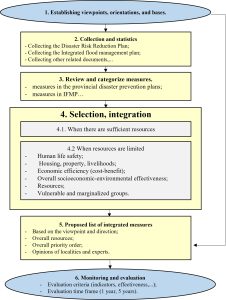
The second section includes the importance of integrating the IFMP into disaster prevention plans and the steps involved. Real-world examples from the locality provide participants with a local perspective, thereby enhancing their understanding of the implementation phases (Figure 3). The steps for integrating IFMP into the Disaster Prevention and Control Plan are implemented through a continuous process. First, perspectives, orientations, and a legal as well as a practical basis need to be established. These elements serve as the foundation for integration, ensuring consistency with overarching objectives, legislative documents, and local realities. Subsequently, relevant documents associated with both the Disaster Prevention and Control Plan and the IFMP are collected and compiled. At the same time, consultations are conducted with experts and community stakeholders. Once the input data have been gathered, a review is carried out to classify measures into structural and non-structural categories across both plans. This step provides the basis for selection. On this foundation, local authorities choose integration measures that are feasible within available resources. They avoid duplication and prioritise those with the greatest effectiveness in safeguarding people, the economy, and the environment. The results are then formalised into a list of integrated measures presented in the Disaster Prevention and Control Plan. These measures are arranged in order of priority according to resources and sustainable development objectives. Finally, periodic monitoring and evaluation are required. This process tracks progress, assesses the effectiveness of disaster risk reduction, makes timely adjustments, proposes alternative measures, and ensures the efficient use of resources throughout implementation.
At the conclusion of the training course, the trainers posed several queries pertaining to the training topics to assess the participants’ comprehension. In this section, we also aim to understand how the concerns raised in the lecture were applied in local, specific circumstances. This section also enables participants to ask any questions, to which the trainers will answer or respond (Figure 4). Through training and discussion, we explained the concerns of the participants, offering details on the methods and their range of applications.
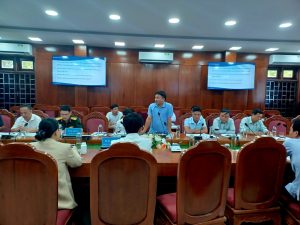
The consensus was that floods are one of the significant natural threats to sustainable development. At all scales, flood control is essential and does not limit the river basin’s geographic extent. In integrated flood management, the implementation of measures for flood control avoids duplication, takes into account coordination among stakeholders, and fully incorporates land use issues, as well as economic, social, and environmental sustainable development, and disaster risk management in floodplains. Additionally, IFMP must be included in provincial disaster prevention plans to prevent duplication in proposed measures. During the integration process, it is necessary to compare the impact of floods on socioeconomic development activities with the impact of other natural disasters, because various types of natural disasters characterise each region.
3.2. Interprovincial/intra-provincial cooperation connection workshop
Interprovincial/intra-provincial cooperation connection workshop was organised for 1 day in each province to discuss three main topics: (i) the current status of flood control measures at the local level, the advantages of integrated flood management, and the role of departments in developing IFMP; (ii) integrating IFMP into the provincial disaster management plan and the role of departments in this integration process; and (iii) benefits, challenges and solutions to overcome these difficulties.
During the discussion, participants representing their respective agencies discussed issues requiring coordination and clarified their responsibilities in relation to other departments. They also examined the challenges encountered during the coordination process and proposed potential strategies to address them (Figure 5).
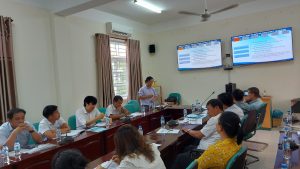
It was determined through discussion that the process of developing and implementing IFMP is a collaborative effort involving multiple sectors and fields, as IFMP employs a multidisciplinary approach, community participation, and support from policies and mechanisms in flood management, and proposes solutions through consultations with many departments and agencies. Therefore, the departments and agencies must clearly understand their roles and contribute effectively to managing flood risks in their respective localities.
3.3. Outputs and evaluations of the participants
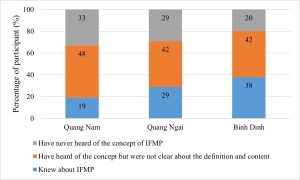
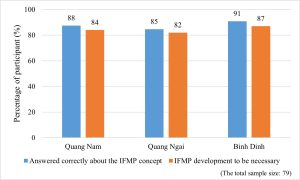
We have developed post-training interview questionnaires to assess the effectiveness of the training in enhancing the participants’ capacity. A total of 82 participants responded to the questionnaire survey. The post-training interview findings revealed that the training provided a foundational understanding to the participants about the idea and the procedure of building an IFMP and incorporating it into provincial disaster prevention. On average, 88% of participants acknowledged IFMP, and more than half of the participants believed that developing an IFPM is necessary (Figures 6 and 7). In addition, the participants gave favourable feedback on the manual’s straightforward presentation, tight execution guidelines, and applicability to local reality.
Regarding the steps of developing IFMP and integrating IFMP into provincial disaster prevention, participants believed that the implementation contents necessitate in-depth knowledge of flooding, inundation, flood risk, and proposing measures. Inadequate human resources to implement the plan, insufficient expertise of local officials in developing IFMP, and insufficient financing from the local government to implement measures may present obstacles. Therefore, participants expressed a desire to participate in more in-depth training courses on these topics, and the locality can develop supplementary tools to serve the flood response and risk reduction efforts.
Regarding local flood management, the participants believed that, in addition to creating IFMPs, localities require data computation and management tools to enable them to make prompt decisions and suggest suitable solutions in flooding situations. Proposed tools include flood forecasting and warning, developing flood risk maps, assessing flood risk according to various calculated scenarios, flood management databases, and response plans.
4. CONCLUSION
Through this capacity building project, efforts were made to support officials through relevant research activities and improved efforts to provide capacity development for officials to meet their specific needs by organising training programmes and developing comprehensive and cross-sector capacity development activities on IFMP. The project results indicated that officials’ scientific understanding of disaster risk management and flood management must be enhanced. Although the natural conditions, flood characteristics, disaster prevention status, and understanding of IFMP varied across individuals and provinces, the project adapted the training content flexibly. The adjustments were based on information collected during field surveys, discussions with local officials prior to the training, and the extent of understanding demonstrated by the trainees during the training session. As a result, they have gained fundamental knowledge about the concept of IFMP, its value in reducing flood risks, the process of developing IFMP, and the inclusion of IFMP in disaster prevention and response strategies. The knowledge obtained during the training courses can enable them to better plan for minimising flood risks and integrating IFMP into comprehensive disaster management plans, thereby ensuring coherence and efficiency in solution implementation.
Moreover, the training sessions not only provided officials with information to enhance their understanding but also sparked their interest in learning more about flood management-related content, creating support tools, and coordinating between departments/agencies in establishing an IFMP. Nevertheless, the more advanced and detailed aspects of IFMP development remain highly complex. While participants acquired a fundamental understanding of the implementation steps and corresponding actions, local agencies still face significant challenges in independently coordinating and institutionalising the development of IFMP. Therefore, they expressed a desire to participate in more in-depth training courses on these topics, and the locality can develop supporting tools to serve the flood response and risk reduction efforts.
5. KEY FINDINGS AND FUTURE DIRECTIONS
Throughout the project execution, we have made some significant discoveries as follows:
- The demand for training in disaster risk management is high, not only for floods but also for a variety of natural disasters. The increasing complexity of these disasters and their effects on socioeconomic growth have heightened awareness of the need for comprehensive and multidisciplinary approaches. However, inadequate risk management and implementation of measures continue to exist.
- Understanding the local natural, socioeconomic, and cultural aspects is crucial when creating training materials and establishing training workshop programmes. The training materials should be straightforward, readily accessible, and tailored to local conditions, allowing participants to easily comprehend and apply the information.
- Participants, particularly local leaders, play a significant role in this effort. Due to the variation in knowledge levels between locales and individuals, it is essential to assess their capacities in advance to design training workshop programmes.
In Vietnam, a community-based disaster risk management and community awareness enhancement plan has been approved by the government to improve the community’s ability at the commune level (Decision 553, 2021). However, not many capacity building programmes are available for local officials in terms of disaster risk and flood management. Therefore, this initiative marks just the first step in improving the capacity of officials in management agencies. With the advancement of science and management techniques, we recognise the need to extend training programmes not only for the three project provinces but also for other provinces throughout the country. In response to the present demands for lowering catastrophe risk and flooding, we suggest the creation of further training courses as follows:
- Organise training courses on flood mapping and flood risk assessment.
- Create tools and software for flood forecasting and detection.
- Establish a flood management database and decision support system.
6. ACKNOWLEDGEMENTS
We would like to convey our thanks to the Asia-Pacific Network for Global Change Research (APN) for their financial and technical support for this important project, under Grant No. CBA2022-03SY-Tran Ngoc. We would also like to express our sincere thanks to the leaders and officials of the Viet Nam Disaster and Dyke Management Authority of the Ministry of Agriculture and Rural Development for providing technical support and engagement in the project. Special thanks are also given to the Steering Committee for Disaster Prevention and Search and Rescue of Quang Nam, Quang Ngai, and Binh Dinh provinces for their enthusiasm and cooperation in this project. Finally, the project could not have been a success without the technical support of various experts and national organisations working on these issues.