
Current situation and capacity building needs of agricultural extension staff in the context of climate change: A case study in mountainous areas of Vietnam
Keywords
Challenges · Climate change adaptation · Extension workers · Training needs
HIGHLIGHTS
- Extension staff in upland Vietnam often serve as generalists, working beyond their academic training and technical expertise.
- Their capacity to support climate adaptation is constrained by limited access to practical training, climate-smart manuals, and demonstration models.
- Climate variability has made extension planning, pest monitoring, and service delivery increasingly difficult, especially in remote areas.
- Participatory and experience-based training methods are strongly preferred and urgently needed.
- Strengthening coordination among extension, scientific, and climate services is key to improving adaptive capacity in mountainous regions.
1. INTRODUCTION
Climate change is intensifying pressures on agriculture globally, affecting food security, ecosystems, and rural livelihoods, especially in vulnerable regions. In Vietnam, climate risks such as extreme temperatures, erratic rainfall, and natural disasters are disrupting agricultural productivity and threatening the livelihoods of smallholder farmers (IPCC, 2022). Although significant attention has been given to climate change adaptation in lowland and coastal areas, the mountainous regions of northern Vietnam remain under-researched despite their heightened vulnerability due to poverty, geographic isolation, and dependence on natural-resource-based livelihoods (Care International in Vietnam, 2013; General Statistics Office [GSO], 2019).
Agricultural extension services play a critical role in supporting farmers to adapt to climate-induced risks through the provision of technical guidance, training, and access to innovations (FAO, 2023; Meera et al., 2012). However, the capacity of extension systems to address climate risks remains uneven, especially in rural upland contexts where access to information and resources is limited. The effectiveness of extension staff depends not only on their technical expertise but also on their ability to translate climate information into actionable advice, facilitate participatory learning, and foster behavioural change among farmers (Antwi-Agyei & Stringer, 2021; Kristjanson et al., 2009).
In the northern mountainous provinces of Thai Nguyen and Bac Kan, home to large populations of ethnic minorities, extension networks face distinct institutional and operational constraints. These include insufficient training in climate-smart agriculture (CSA), lack of exposure to demonstration models, fragmented cross-sectoral coordination, and limited tools for gender-responsive and participatory outreach (Ha et al., 2020; Le & Tran, 2020). A generalist approach, where extension workers are required to cover multiple technical fields beyond their expertise, further compounds these limitations (Sulaiman & Davis, 2012; Wossen et al., 2017).
While government policies have increasingly acknowledged the role of extension services in climate change adaptation, the actual support mechanisms remain weak, particularly in mountainous and ethnically diverse areas (Le et al., 2021). There is limited evidence on how current capacities, challenges, and training needs vary across extension personnel, and how these gaps affect the delivery of climate-resilient agricultural services.
This study addresses these gaps by assessing the current situation and capacity-building needs of agricultural extension staff in Thai Nguyen and Bac Kan provinces. Specifically, it examines demographic characteristics, existing capacity in climate change adaptation, key challenges faced in the field, and priority training demands. The findings aim to inform context-specific policy and programmatic interventions to enhance the adaptive role of extension systems in vulnerable mountainous regions.
2. LITERATURE REVIEW
Agricultural extension has long been recognised as a crucial instrument for improving rural livelihoods and enabling the diffusion of innovations. In the context of climate change, its role has become even more central, as extension workers are expected to assist farmers in understanding, anticipating, and responding to new climate-related risks (Anderson & Feder, 2007; FAO, 2023).
The literature highlights that effective climate-responsive extension requires competencies not only in technical domains, but also in climate literacy, risk communication, participatory engagement, and the use of decision-support tools (Kristjanson et al., 2009; Meena et al., 2021). However, these requirements are often unmet in developing-country contexts, where extension systems are under-resourced and staff are poorly trained in climate-related subjects (Sulaiman & Davis, 2012).
Studies in Vietnam indicate that agricultural extension networks, particularly in mountainous areas, face a number of structural and operational limitations. These include staff shortages, lack of specialised training, and limited collaboration with meteorological and scientific institutions (Ha et al., 2020; Le et al., 2021). Moreover, the generalist nature of most extension roles means that staff are often required to operate beyond their academic specialisations, covering multiple production sectors with limited support (Care International in Vietnam, 2013).
Empirical research also reveals a lack of demonstration sites or successful climate adaptation models that extension workers can showcase to farmers. This gap undermines their credibility and limits the uptake of climate-resilient practices (Antwi-Agyei & Stringer, 2021). Finally, most training programs remain top-down and theoretical, with limited opportunities for peer-to-peer exchange, practical field experience, or gender-responsive approaches (Le & Tran, 2020; Wossen et al., 2017).
This study builds on this body of literature by providing empirical evidence on the knowledge, skills, challenges, and support needs of extension personnel in two of Vietnam’s most climate-vulnerable provinces. It adds value by disaggregating insights across staff roles (leaders vs. field officers), identifying gaps in access to training and resources, and capturing extension workers’ preferences for learning and skill development.
3. METHODOLOGY
3.1. Study locations
This study was conducted in two provinces, namely, Thai Nguyen and Bac Kan, which belong to the northeast subregion of Vietnam. The two provinces have rather similar climatic conditions and socioeconomic characteristics (Figure 1).
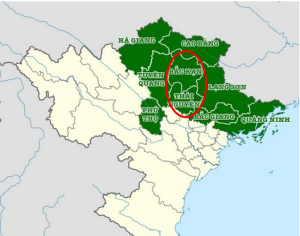
Thai Nguyen province has three cities and six districts with 178 communes, wards and towns. The population of Thai Nguyen (by 2021) was about 1.3 million people, of which ethnic minorities account for nearly 30% (Thai Nguyen Portal, 2021). The climate of the province is divided into four distinct seasons. The average annual sunshine duration ranges from 1,300 to 1,750 hours, and the average annual precipitation ranges between 2,000 and 2,500 mm. The natural land area of Thai Nguyen is over 3,500 km2 (Thai Nguyen Portal, 2021). In general, Thai Nguyen has an advantageous climate for agricultural and forestry development. However, a recent study by Ha et al. (2020) revealed that local farmers are very vulnerable to the impact of climate change. Reduced crop/livestock productivity and crop failure were stated by 60.9% and reduced production land and number of crops per year were stated by 44.6% of interviewed farmers.
Bac Kan province has one city and seven districts with 108 communes, wards, and towns. The province has 88% of the population being ethnic minorities (Bac Kan PPC, 2020). Bac Kan has 13,867 poor households, accounting for 17.02% and 8,239 near-poor households, accounting for 10.11% (MOLISA, 2022). The rate of poor and near-poor households in the province is 7.7 times and 3.3 times higher than the national average, respectively. The province has more than 75% of the population living in rural areas (Bac Kan PPC, 2021).
In the period from 2008 to 2018, the average annual temperature of Bac Kan province increased by 0.8 °C compared to 48 years ago. The total annual rainfall during this period also had an unusual increase and decrease. Extreme weather phenomena such as storms, flash floods, landslides, soil erosion in mountainous areas, and droughts occur more frequently and unusually in the province. Since 2016, heat waves have appeared earlier in the year, heat waves have become more intense and longer lasting, with common highest temperatures ranging from 38–40 °C. In particular, unseasonal heavy rains appear more often in January and March, causing unseasonal floods. Winter is warmer because the average monthly temperature is 1–2 °C higher than the average for many years, but the difference in day and night temperatures is very large. Freezing rain and frost appear more often at night and early in the morning. The above changes in weather have caused great damage to local agricultural production (Bac Kan PPC, 2020). With a high rate of poor households and a large proportion of workers working in the agricultural sector, communities in Bac Kan province are even more vulnerable to the effects of climate change.
3.2. Study design and sampling approach
A cross-sectional survey design was applied. The survey was conducted between 2021 and 2022 in 8 districts/cities per province. Respondents were selected through stratified sampling, with strata based on location, gender, age, and staff roles (leaders vs. workers). In total, 151 participants were interviewed, including 26 leaders and 125 field-level extension workers. This sample included 3–4 people from each provincial extension centre and nine respondents per district/city.
The rationale for separating respondents into two groups lies in their differing perspectives and responsibilities. Leaders generally oversee planning and can offer system-level assessments of the extension workforce’s capability, while workers provide practical insight on service delivery and training needs.
3.3. Questionnaire design and data collection
Two semi-structured questionnaires were developed, one for leaders and one for extension workers. Each covered four sections:
- Demographic characteristics,
- Experience with climate change adaptation (CCA),
- Self-assessment of knowledge and capacity,
- Training needs and preferred learning methods.
Data was collected through in-person interviews and recorded in standardised formats. Closed-ended questions used multiple-choice, 5-point Likert scales, and scoring matrices, while open-ended questions allowed respondents to elaborate on challenges and priorities.
3.4. Data analysis
Quantitative and semi-quantitative data were analysed using SPSS (version 20). Descriptive statistics (means, percentages, and frequencies) were used to summarise the findings. Where applicable, responses were disaggregated by staff type (leader vs. worker) and province to reveal patterns across roles and contexts.
4. RESULTS
4.1. Demographic characteristics of agricultural extension workers
4.1.1. Gender, age and work experience
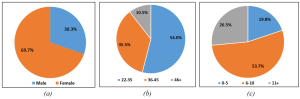
The extension workforce in the study area was predominantly female (69.7%), nearly double the proportion of male workers (30.3%) (Figure 2a). The majority (54%) of workers were between 22 and 35 years old, while 35.5% were aged 36–45 and 10.5% were 46 or older (Figure 2b). Over half (55%) had 6–10 years of experience, while 25% had over 10 years and 20% were new entrants with fewer than 5 years (Figure 2c).
4.1.2. Education level and specialisation
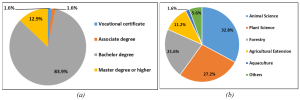
Most respondents (83.9%) held a bachelor’s degree, with 12.9% having a master’s or higher degree. Only a few had associate degrees or vocational certificates (1.6% each) (Figure 3a). Main fields of study included Animal Science (32.8%), Plant Science (27.2%), and Forestry (21.6%). Notably, only 11.2% specialised in Agricultural Extension (Figure 3b).
4.1.3. Scope of work and responsibilities
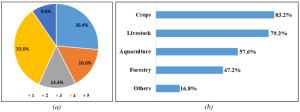
Despite their academic specialisation, only 26.4% worked within their trained discipline. The majority were responsible for 2–5 domains, including crops, livestock, aquaculture, and forestry. The most common fields covered were crop cultivation (83.2%) and livestock (79.2%) (Figure 4).
4.2. Knowledge, capacity and experience in climate change adaptation (CCA)
4.2.1. Sources of climate information among extension workers
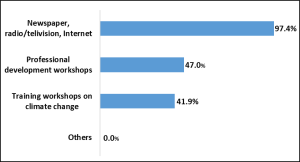
Extension workers relied heavily on mass media (97.4%) to learn about climate change, followed by training workshops (47%) and professional events (41%) (Figure 5).
4.2.2. Self-assessment of climate understanding among extension workers
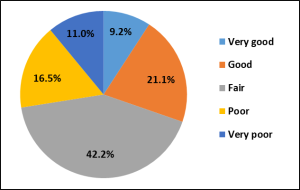
About 42.2% rated their climate knowledge as fair, while roughly 30% rated it as good/very good and 27% rated it as poor/very poor (Figure 6).
4.2.3. Perceptions of local climate change among extension workers
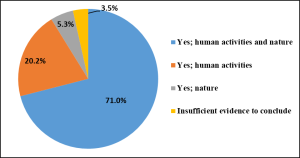
Most respondents (96.5%) confirmed visible signs of climate change. Regarding causes, 71% cited both human and natural influences, while smaller percentages blamed only one factor or lacked sufficient knowledge (Figure 7).
4.2.4. Climate-related phenomena observed
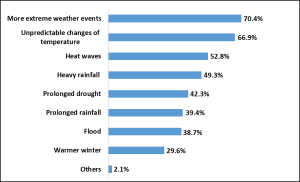
The most commonly observed phenomena among both leaders and extension staff were extreme weather events (70.4%) and temperature fluctuations (66.9%), followed by heatwaves (52.8%) and heavy rainfall (49.3%) (Figure 8).
4.2.5. Impacts on local agriculture
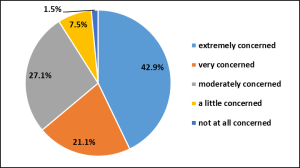
Extension leaders and workers were asked to rate the impacts of climate change on local agricultural production on a scale of 1 to 5 (1 being not at all concerned and five being extremely concerned). The results indicate that most respondents expressed concern about climate change’s impacts on agriculture. Over 42% were extremely concerned, 21.1% very concerned, and 27.1% moderately concerned (Figure 9).
4.2.6. Practical experience with CCA among extension staff
The extension workers were asked about their participation in activities related to climate change adaptation in agriculture. The results were used to provide an overview of their experience in climate change adaptation. More than half of the extension workers (58.1%) had participated in extension activities related to climate change adaptation, such as dissemination, training, and transferring agricultural techniques. However, the proportion of workers without experience in climate change adaptation was relatively high, at 41.9% (Figure 10a).
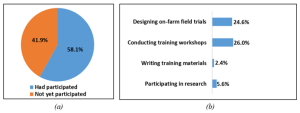
Extension workers were also asked to specify the climate change adaptation activities they had participated in over the last five years. The most common activities were conducting training workshops for local farmers and designing on-farm demonstrations. However, the proportion of the respondents carrying out these activities was quite low, at only 26.0% and 24.6%, respectively. A small proportion of workers stated that they had participated in technical research (5.6%) and writing training materials (2.4%) (Figure 10b).
4.2.7. Technical training received
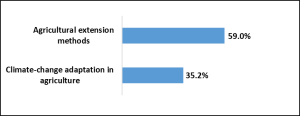
About 59% had been trained in agricultural extension methods, but only 35.2% had received training on climate adaptation in agriculture (Figure 11).
4.2.8. Assessment of the professional capacity of extension workers
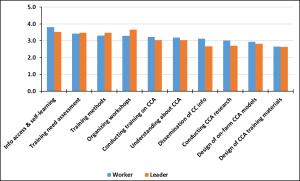
This section presents an assessment of the capacity of extension workers from the viewpoints of both leaders and extension staff. In general, the competency score of agricultural extension officers was in the range of 2.5 to 4.0 in all criteria, and the two groups of respondents (leaders and extension workers) gave quite similar scores in the criteria. While knowledge/skills related to self-study and extension activities were generally rated above average, competencies related to CCA were given lower scores. As shown in Figure 12, leaders rated the extension workforce’s understanding of climate change adaptation (CCA) and their capability to perform CCA-related tasks lower than the self-assessments provided by the extension workers themselves.
4.3. Key challenges and training needs in the context of climate change
4.3.1. Challenges of extension staff in the context of climate change
Travel for farm visits and other extension activities became more difficult due to heavy rain and more frequent/intense extreme flood events. In remote mountainous areas where transportation infrastructure is not well developed, flooding can easily damage low-quality roads and bridges, isolating these areas. This isolation not only prevents extension workers from reaching communities but also limits farmers’ participation in training activities.
The development and implementation of agricultural production plans became passive due to unpredictable weather such as erratic drought, heavy rainfall, and unusual winter heat. For instance, unpredictable temperature changes have disrupted flower production scheduling, reducing yield and quality. Cut flowers typically earn higher prices when timed with New Year’s holidays, yet flowering time, governed by environmental stimuli like temperature, has become harder to control.
Difficulties in forecasting and monitoring pests and diseases in crops and livestock have also intensified. Shifting climate patterns have increased the risk of outbreaks, making pest and disease monitoring more challenging.
Workload pressures have increased. Extension workers must invest more time rescheduling crop plans and managing emerging pest and disease challenges. Additional time is required for learning about new risks, thereby stretching already limited resources.
Dissemination of new technologies sometimes lags behind changing climate conditions. New rice varieties selected under previous seasonal expectations may become ill-suited due to sudden climatic shifts. Furthermore, on-farm trials face an elevated risk of failure from extreme weather.
Finally, there is a persistent shortage of climate-smart production manuals, limited access to practical training, and few on-site showcases or models for peer learning.
4.3.2. Training demand and preferred learning methods
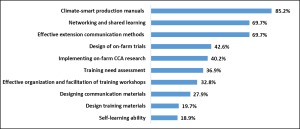
Climate-smart production manuals (for crops and livestock) were selected by 82.5% of respondents as the top training need. Networking and shared learning, along with communication methods for local farmers, followed closely at 69.7%. Skills in designing on-farm demonstration plots (42.6%) and conducting applied research on adaptation (40.2%) were also noted. Less than one-third selected training design, workshop facilitation, or multimedia communication tools. The least interest was expressed for self-learning strategies and creating training materials (under 20%) (Figure 13).
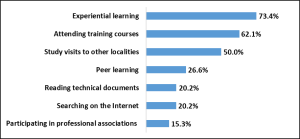
Survey results revealed that experiential learning, formal training courses, and study visits were perceived as the most effective learning methods. These were selected by 73.4%, 62.1%, and 50.0% of the workers, respectively. Peer learning, reading documents, and internet research were less favoured, each selected by only around 20% of respondents. Online associations or social network-based learning ranked lowest at 15.3% (Figure 14).
5. DISCUSSION
The findings highlight a mismatch between the expectations placed on extension staff and their current knowledge, training, and access to resources. While extension officers generally possess formal qualifications and work experience, they face significant challenges in performing climate-resilient advisory functions. A majority of staff operate across multiple disciplines, often outside their area of training. This generalist expectation, combined with limited resources and institutional support, reduces the effectiveness of extension systems in responding to climate risks.
Access to practical training on CCA and exposure to working demonstration models remain critically low. Staff members also expressed limited confidence in their technical understanding of climate science and adaptation strategies, with few having participated in hands-on capacity-building activities. These findings align with previous studies indicating the limited readiness of Vietnam’s upland extension systems to deliver climate-informed services (Care International in Vietnam, 2013; Ha et al., 2020). This also resonates with similar constraints in other developing countries where decentralisation and limited resourcing hinder staff development (Sulaiman & Davis, 2012; Antwi-Agyei & Stringer, 2021).
The results further reveal that climate change has exacerbated longstanding structural and institutional challenges in agricultural extension systems in the mountainous regions of Vietnam. The intensification of extreme weather and climatic variability has rendered traditional planning and forecasting mechanisms inadequate, especially in locations with fragile infrastructure and limited service access.
Travel disruptions, workload intensification, and the failure of scheduled activities, such as floriculture timing, highlight how localised climate stressors directly affect the quality of service delivery. These findings mirror earlier research emphasising that extension services often lack the resilience and flexibility to respond dynamically to climate uncertainty.
The challenge of pest and disease forecasting further reflects the findings of the IPPC Secretariat (2022) and Stephen and Soos (2021), who anticipate rising biotic stress under climate change in tropical regions. As these outbreaks become more complex, extension workers must expand their capacity to monitor and interpret biophysical risks – skills not yet widely developed in the workforce.
Moreover, the disconnect between technology trials and emerging climate conditions reveals a critical adaptation gap in knowledge transfer systems. As Sulaiman and Davis (2012) note, generalist extension staff, especially those working in marginal and upland areas, require continuous skill updating and field-oriented models to remain relevant.
The study also affirms that most workers prefer participatory and practical learning methods over theoretical or digital formats. This preference suggests that any new training design should prioritise field-based demonstration, experience exchange, and peer mentoring, rather than traditional lectures or online modules. It also underscores the importance of co-learning frameworks that enable field agents to build adaptive knowledge together.
Overall, the results indicate the need for sustained investment in capacity development systems that recognise the geographic, gender, and role-based diversity of Vietnam’s extension workforce. Tailored and locally grounded training, focused on actionable, climate-resilient skills, should be the cornerstone of future policy reforms in this sector.
Limitations of this study:
While this study provides valuable insights into the capacity and training needs of agricultural extension staff in the northern mountainous provinces of Vietnam, several limitations should be acknowledged.
Geographical scope: The research focused only on two provinces, Thai Nguyen and Bac Kan. Although representative of the northern mountainous region, these provinces may not capture the full diversity of agro-ecological conditions, institutional arrangements, and extension practices across other upland provinces of Vietnam. Findings should, therefore, be interpreted with caution when applied to other regions.
Sample size: The survey covered 151 respondents, including both leaders and extension workers. While this number was adequate to identify general patterns and trends, it remains relatively modest compared to the total extension workforce in the study provinces. This may limit the statistical power of the analysis and the ability to detect finer distinctions across subgroups.
Methodological limitations: The study employed a cross-sectional survey design, which captures perceptions and capacities at a single point in time. Such a design cannot establish causal relationships between identified challenges, training needs, and the broader institutional context. Longitudinal studies would be required to assess how extension capacities evolve over time and in response to interventions.
Generalisability of results: Given the study’s geographic and sample constraints, as well as the specificity of local socio-economic and climatic conditions, the findings cannot be generalised to all agricultural extension systems in Vietnam or other developing countries. Instead, they should be understood as context-specific insights that highlight trends and capacity needs in two climate-vulnerable provinces.
Acknowledging these limitations provides important context for interpreting the results and underscores the need for future research with broader geographic coverage, larger sample sizes, and more diverse methodological approaches.
6. CONCLUSION
This study examined the current situation, capacity gaps, and training needs of agricultural extension staff in two climate-vulnerable provinces of northern Vietnam. The findings confirm a critical mismatch between the increasingly complex demands placed on extension services and the limited technical training, resources, and institutional support available to staff, especially in upland and ethnic minority areas.
While most staff are formally trained and experienced, they often serve as generalists across multiple disciplines, frequently outside their academic specialisations. Access to climate-smart production manuals, demonstration models, and experiential training remains insufficient. Challenges such as climate variability, infrastructure limitations, and emerging pest and disease threats further complicate their ability to deliver responsive, adaptive services.
To improve the effectiveness and climate resilience of agricultural extension systems, national and provincial governments should consider the following priorities:
- Develop climate-smart agricultural training manuals tailored to local agroecological conditions and farming systems. These manuals should be widely accessible to district- and commune-level staff.
- Strengthen participatory and experiential learning mechanisms, such as field-based training, peer learning exchanges, and cross-provincial study visits.
- To enable timely, integrated support, improve inter-agency coordination between extension systems, climate scientists, meteorological services, and disaster risk management authorities.
By investing in these areas, the government can strengthen the responsiveness and equity of extension services, ultimately supporting more resilient smallholder livelihoods and adaptive agricultural development in Vietnam’s mountainous regions.
7. ACKNOWLEDGEMENT
We would like to express our sincere gratitude to the Asia-Pacific Network for Global Change Research (APN) for funding this project under Grant No. CBA2021-10SY-Hoang.
We would also like to express our sincere thanks to government officials, agricultural extension leaders and workers in Thai Nguyen and Bac Kan provinces who participated in the survey directly and indirectly by providing their support for the implementation of the survey and their valuable time and input for this study.