

Framework for evaluating rural ecosystem restoration programs in Asia
Keywords
Climate change adaptation · NATURE-BASED SOLUTIONS (NBS) · Resilience · Rural livelihoods · SOCIOECOLOGICAL SYSTEMS (SES) · SOCIOECONOMIC EVALUATION
HIGHLIGHTS
- A framework combining ecological and livelihood-based indicators was developed.
- Regional differences in ER evaluation were identified across 17 Asian countries.
- Integration of socioeconomic data in current ER case studies was found to be limited.
- The significance of climate factors in restoration assessments is highlighted.
- The need for context-specific ER evaluation tools in rural Asia is highlighted.
1. INTRODUCTION
Across Asia, the impacts of climate-related disasters, such as droughts and floods, are particularly severe, with significant variation in their effects depending on the country and type of ecosystem. Ecosystem-based Adaptation (EbA) has been implemented as a broad approach to address climate change; however, its effectiveness needs to be more rigorously examined within specific socioecological contexts. Ecosystem restoration (ER), a process that involves human intervention to support the recovery of degraded ecosystems, aims to maintain ecosystem services. In Asia, numerous localised ER projects have been carried out; however, their socioeconomic impacts have not been adequately quantified due to a lack of scientific evaluations grounded in locally validated indicator frameworks.
Our explicit focus on rural areas stems from the distinct socioecological vulnerabilities embedded in these landscapes. Rural communities across Asia experience a tight, direct feedback loop between ecosystem health and economic stability, as their primary income sources are inherently tied to local provisioning services (Xu et al., 2009), such as rainfed farming in China, livestock husbandry in Mongolia and cattle grazing in Japan. Furthermore, while major national restoration policies target vast rural territories, their long-term viability is heavily modulated by local socioeconomic configurations (Bennett, 2008). This requires dedicated evaluative frameworks designed specifically for rural configurations rather than urban or semi-urban systems.
In this context, anchoring the evaluation in rural resilience is imperative, yet the concept demands a more robust conceptual formulation within socioecological literature. In dynamic socioecological systems, rural resilience represents far more than a passive, reactive capacity to cope with immediate external climate shocks like catastrophic droughts and floods. Rather, it fundamentally encompasses the proactive adaptive capacity of communities to transform their livelihoods, build diverse capital assets, and maintain institutional and social security under shifting environmental regimes (Folke et al., 2010; Speranza et al., 2014). Therefore, quantifying exposure and vulnerability to climate-induced hazards enables assessment of how human interventions, namely ER, dynamically reshape these socioecological systems over time (Fedele et al., 2019).
To establish a clear analytical direction, the present study establishes explicit guiding expectations. In the study, a framework for evaluating ER’s potential to enhance rural resilience in Asia was developed, focusing on its impact on rural livelihoods and its capacity to reduce vulnerability to climate risks and climate-induced disasters. We hypothesise that effective ER enhances rural resilience through a dual-pathway mechanism: first, by stabilising and restoring vital regulating ecosystem services (e.g., reducing soil erosion rate and improving landscape water retention); and second, by simultaneously translating these environmental gains into tangible socioeconomic co-benefits (e.g., diversifying into off-farm employment, augmenting income levels and strengthening multi-faceted household security assets). The primary objective of this study was to identify the key characteristics and processes of ER that strengthen rural resilience in Asia, and to comprehensively evaluate the effects of ER on rural livelihoods, ecosystems and climate-related risks. As resilience is defined as the ability of communities to cope with external risks, quantifying exposure and vulnerability to climate-induced hazards enables assessment of the impacts of human interventions (ER) on socioecological systems. Considering that ER processes influence these systems over time, the analysis must encompass a comprehensive evaluation across temporal, spatial and stakeholder dimensions, while accounting for policy outcomes and governance structures. This study proposes an evaluation framework for ecosystem restoration programs in Asia. To extract regional characteristics and validate the framework, existing evaluation cases based on this framework are reviewed.
2. METHODOLOGY
2.1. Framework development based on the data synthesis workshop
In October 2023, a data synthesis workshop was convened for researchers from several Asian countries, including Bangladesh, China, Mongolia and Japan, to integrate evaluation indicators for the Environmental Restoration (ER) program in Asia (see APN Final Report CRRP2022-02MY-Shoyama). During the workshop, the objectives, activities, findings and policy recommendations of each research case study were synthesised and reviewed.
During the workshop, ecological restoration (ER) cases in three regions of China, Mongolia and Japan were comparatively analysed. The focus was on extracting and comparing information on ecosystem types, degradation factors, environmental issues and local livelihoods for each region.
The choice of these specific sites reflects the major distinct agroecosystems across East and Central Asia: a watershed agroecosystem suffering from climate-induced soil erosion (Loess Plateau, China); a wetland agroecosystem threatened by anthropogenic tourism and water pollution (Lake Ugii, Mongolia); and a grassland agroecosystem facing biodiversity loss due to changing traditional management (Aso Volcano Zone, Japan). This structural variation ensures the representativeness of diverse degradation drivers and rural livelihood configurations in the region, while leveraging long-term monitored data available through the collaborative APN network.
China:
The case from China focuses on the Luoyugou watershed in the Loess Plateau, characterised by a watershed agroecosystem. Key drivers of degradation include climate change and land-use change, with soil erosion as the primary environmental concern. Rainfed and dryland farming are the primary sources of livelihood in the local area.
Mongolia:
The Mongolian case focuses on Lake Ugii, a wetland agroecosystem, where the primary causes of degradation are climate change and human activities, particularly tourism. The leading environmental issue is water pollution. The primary sources of livelihood are livestock husbandry and tourism.
Japan:
The Japanese case focuses on the Aso Volcano Zone, which features a grassland agroecosystem in which poor grassland management is a key factor in degradation, contributing to biodiversity loss and landslides. Cattle rearing, other livestock production and tourism are the main sources of livelihood.
The indicators extracted from all three regions are as follows.
- Biophysical conditions: precipitation, annual runoff, land use/cover
- Ecological effects: soil erosion rate, soil retention capacity, water retention
- Economic effects: income structure, income level, labour input
- Social effects: agricultural employment, off-farm employment, health index, participation in decision making
A significant point raised during the discussions was the need to distinguish between environmental and economic restoration, as well as the importance of reflecting site-specific issues and contextual conditions in the evaluation process. Based on this understanding, evaluation indicators derived from the three study sites were systematically organised and consolidated into a unified evaluation framework based on the following principles:
- Indicators should be selected to reflect ecological, economic and social impacts, considering the unique issues and characteristics of each site.
- Climate parameters must be incorporated to assess the influence of climate change adequately.
- Temporal changes should be captured through pre- and post-intervention evaluations.
The indicators are classified into two main categories: (1) ecosystem service indicators, encompassing provisioning, regulating, cultural and supporting functions; and (2) livelihood indicators, evaluated at both community and household levels. These indicators include dimensions such as education, civic participation, health, access to social services, and multiple facets of security, specifically food, economic, health, educational, social and institutional security (Figure 1).
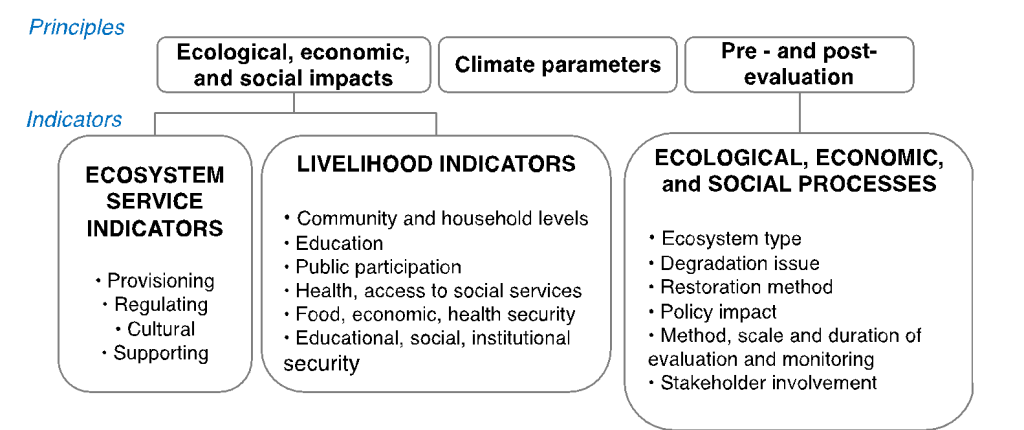
The development and architectural configuration of the integrated evaluation framework utilised a hybrid approach that harmonises both inductive and deductive scientific methodologies. Rather than relying solely on a singular direction, the framework was built through an iterative, multi-step process that transitioned from localised biophysical indicators to broader theoretical socioecological dimensions. Inductively, the process began by extracting raw, site-specific biophysical and socioeconomic indicators from the localised characteristics of the three focal target countries during collaborative data synthesis workshops. These initial data points captured the empirical realities of rural livelihood strategies and drivers of landscape degradation specific to China, Mongolia and Japan. Deductively, these concrete, bottom-up indicators were systematically consolidated and structured under the guidance of established conceptual models in sustainability science. Specifically, we anchored the environmental components within the Millennium Ecosystem Assessment (MA) classification (Millennium Ecosystem Assessment [MEA], 2005), while the human dimensions were aligned with the Social-Ecological Systems (SES) framework (Binder et al., 2013) and the Sustainable Livelihoods Framework (SLF) (Scoones, 1998). Through this theoretical lens, the raw local data were filtered, refined and grouped to avoid redundancy. This framework, comprising ecosystem service indicators and livelihood indicators, was subsequently applied to the evaluation case studies to identify commonalities and divergences in restoration outcomes among the participating Asian countries.
Within this framework, “Supporting services” (such as nutrient cycling, soil formation and primary habitat maintenance) are treated as biophysical baselines or ecological health preconditions. They represent the underlying foundational capacity of the socioecological system rather than direct deliverables to human beneficiaries. Consequently, the socioeconomic evaluation matrix and the subsequent livelihood security assessments are confined to “final ecosystem services” that are directly intercepted, utilised, or experienced by rural households (e.g., crop yield for provisioning, water purification and soil retention for regulating and ecotourism revenue for cultural services). By excluding supporting services from the direct socioeconomic and economic valuation lines and repositioning them as structural precursors, the integrated framework captures the holistic biophysical state of the ecosystem while ensuring a logically and mutually exclusive evaluation of human well-being.
2.2. Literature review of ecological restoration programs in Asia
A literature review was conducted in March 2025, using publications sourced from ScienceDirect, a major full-text scientific database. Peer-reviewed papers were identified using keyword combinations related to ecological restoration and 26 target countries in Asia. The detailed procedure is as follows.
- Search Terms: We applied combining target concept keywords: (“ecosystem restoration” OR “ecological restoration” OR “revegetation” OR “reforestation”) AND (“Asia” OR [individual names of the 26 target countries]).
- Time Coverage: The review covered peer-reviewed literature indexed in ScienceDirect from 1995 to 2024.
- Inclusion/Exclusion Criteria: We have provided a structured breakdown. For instance, we explicitly included empirical, peer-reviewed case studies that evaluated an implemented ER program and contained quantifiable socioeconomic or livelihood indicators. We excluded purely conceptual papers, theoretical policy reviews and scenario modelling studies with no empirical post-intervention data.
In the first stage, the titles and abstracts of the initial 1697 results were independently screened by the authors to assess their relevance to actual ER implementation across the target countries, resulting in 495 articles. In the second stage, full-text assessments of these 495 articles were performed to verify the integration of socioeconomic evaluation methodologies (such as household surveys, income changes, or civic participation indicators), resulting in the final 65 peer-reviewed case studies. Reviews, policy analyses, scenario modelling, stakeholder and management research, and studies focusing on only program preferences, ecosystem functions, habitat evaluation, natural recovery, technological development and climate change impact assessments were excluded. Subsequently, case studies involving socioeconomic evaluation were selected for analysis. In total, 65 articles were retained for in-depth review, following the procedures illustrated in Figure 2. These studies (n = 65; see Reference list) were systematically analysed to extract indicators of ecological restoration programs across diverse cultural contexts in Asia. The diagram illustrates the systematic reduction from the initial search results across 26 Asian countries to the final evaluated dataset of 65 socioeconomic publications. A total of five countries were excluded during the first screening phase because no empirical case studies matched the combined biophysical and restoration criteria, and an additional four countries were subsequently removed during the second socioeconomic screening phase, resulting in a final geographic coverage of 17 countries.
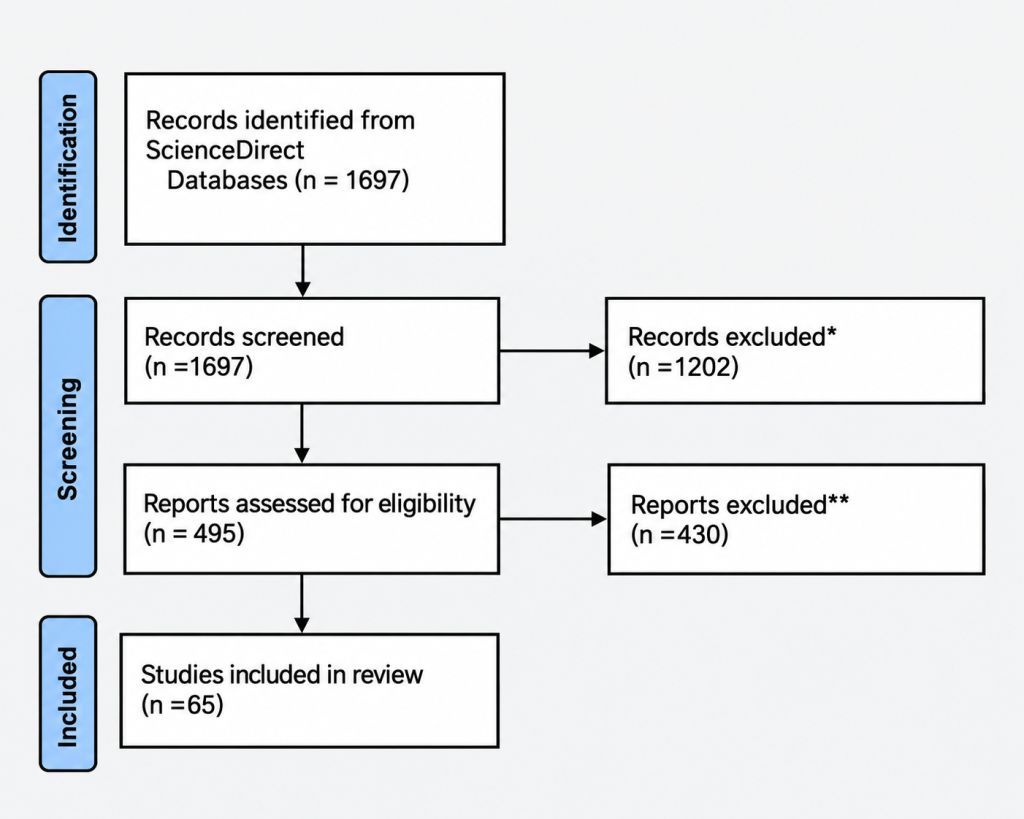
- * Exclusion of non-relevant articles based on abstracts with careful screening for assessment cases on the ecological restoration program.
- ** Exclusion of non-relevant articles based on abstracts with careful screening for assessment cases on socioeconomic evaluations.
2.3. Text mining and analysis
To extract broad geographical patterns in target ecosystems, restoration approaches, evaluation methods and spatial scales from the initially screened dataset (n = 495), a structured text-mining analysis was performed using R (version 4.4.2).
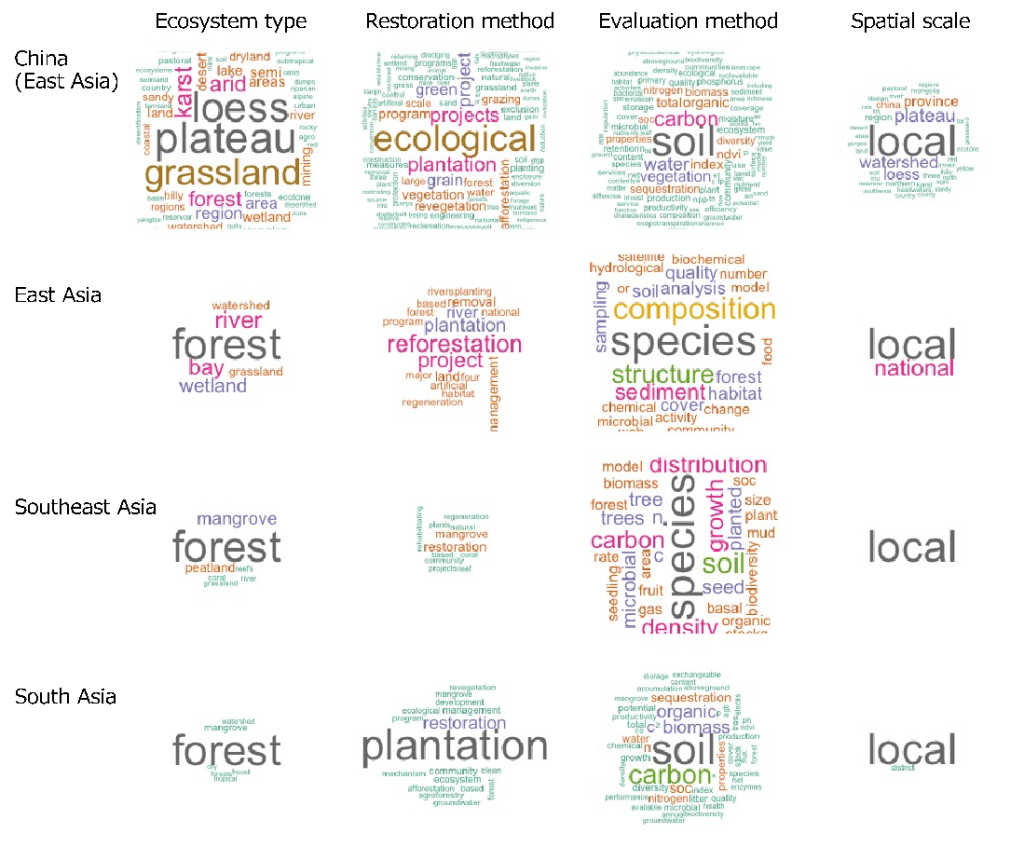
First, the text corpus was constructed by extracting metadata from four specific qualitative classification columns within the curated database, i.e. ecosystem type, restoration method, evaluation method and spatial scale. The analysis was stratified chronologically by unique target countries to capture localised research trends. Next, text cleaning and tokenisation were executed utilising the ‘stringr’ and ‘dplyr’ packages. For each country-specific sub-corpus, the qualitative text entries were converted to lowercase, stripped of all punctuation marks and split into individual word tokens. Standard English stop words (e.g., “and”, “the”, “of”, “to”) along with dataset-specific uninformative terms were systematically filtered out using a custom stop-word vector. Finally, word frequency distributions were calculated directly using descriptive contingency tables for each target category column. The final visual synthesis was generated using the ‘wordcloud’ package, in which the visual scale and central positioning of each term are strictly proportional to its raw empirical frequency in the respective country’s evaluation profile.
3. RESULTS AND DISCUSSION
3.1. Screening results and text analysis of registered cases
The initial screening process resulted in the registration of 495 cases in the database, comprising 384 cases from East Asia, 51 from Southeast Asia and 60 from South Asia. A marked geographical bias was observed, with a disproportionately large number of cases (n = 336) originating from China (Figure 3).
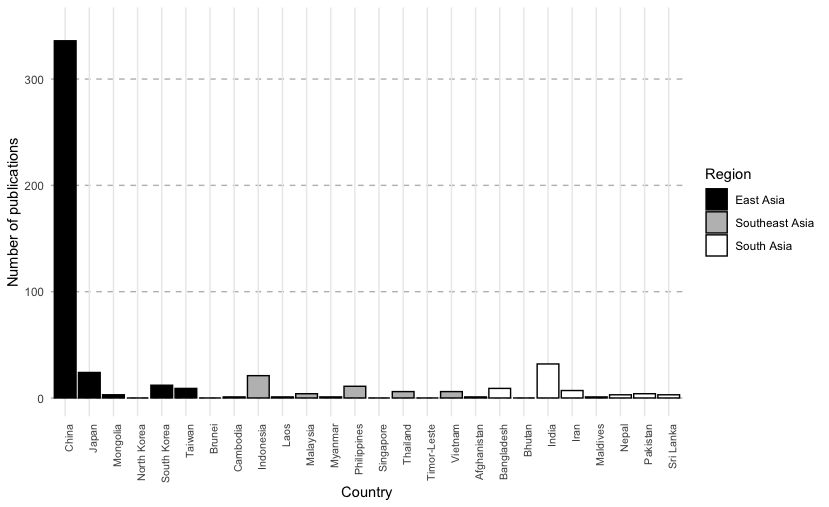
In contrast, the second screening revealed 65 cases suitable for detailed review: 25 from East Asia, 19 from Southeast Asia and 21 from South Asia. This distribution did not exhibit a significant regional bias. These results suggest that many of the initially registered cases focused primarily on ecosystem assessments and lacked components related to socioeconomic evaluation.
A text analysis was conducted on all 495 cases registered in the database and the results are presented in Table 1 and Figure 4, which illustrates the types of ecosystems targeted, the restoration methods employed, the evaluation indicators used and the spatial scales applied across different regions. Table 1 reveals the distinctive characteristics of each region, such as “soil (China, South Asia),” “forests (common to all regions),” and “mangroves (Southeast Asia)”. Figure 4 shows more details, for instance, in China, East Asia places greater emphasis on soil characteristics. In contrast, in East and Southeast Asia, the species selected for restoration and replanting are relatively weighty.
| Subregion | Rank | Keyword | Count |
|---|---|---|---|
| East Asia (China) | 1 | soil | 165 |
| 2 | restoration | 105 | |
| 3 | ecological | 95 | |
| 4 | local | 92 | |
| 5 | plateau | 87 | |
| East Asia | 1 | forest | 21 |
| 2 | restoration | 14 | |
| 3 | local | 13 | |
| 4 | river | 13 | |
| 5 | species | 10 | |
| South Asia | 1 | forest | 47 |
| 2 | local | 45 | |
| 3 | soil | 33 | |
| 4 | plantation | 25 | |
| 5 | carbon | 19 | |
| South East Asia | 1 | local | 47 |
| 2 | forest | 32 | |
| 3 | reforestation | 29 | |
| 4 | mangrove | 17 | |
| 5 | species | 8 |
3.2. Trends in socioeconomic evaluation in ecosystem restoration cases in Asia
Here, 65 academic articles from 17 Asian countries, including China, Japan, South Korea, Taiwan (East Asia), Cambodia, Indonesia, Malaysia, Philippines, Thailand, Vietnam (Southeast Asia), Afghanistan, Bangladesh, India, Iran, Maldives, Pakistan, Sri Lanka (South Asia), that report on ecosystem restoration (ER) projects incorporating socioeconomic evaluations were reviewed. By classifying these cases into three major subregions—East Asia, Southeast Asia and South Asia—the key issues addressed, the trends in evaluation and the characteristics of socioeconomic perspectives in each context were elucidated.
In East Asia, China reported the highest number of cases, with 18 studies focusing primarily on ecosystem service management, drought adaptation and agricultural policy in relation to land use. In many of these studies, large-scale, state-led initiatives, such as the “Grain for Green” program (Zhang et al., 2019), are evaluated, with an emphasis on policy effectiveness and the behavioural responses of rural populations. In Japan, only two cases, focusing on forest management (“satoyama” as a traditional rural landscape) and coastal conservation, were identified. These evaluations highlighted community-led, long-term restoration efforts supported by sophisticated land use systems (Furukawa et al., 2019; Senzaki et al., 2017). Taiwan presented four cases that addressed land use in peri-urban areas and biodiversity conservation, with a focus on institutional responses to high-density land use and the role of participatory governance (Chiu et al., 2020; Lee & Shih, 2004; Lin et al., 2020; Tu & Chen, 2020). In South Korea, only one case, which dealt with urban green space restoration from a citizen-oriented perspective (Lee & Youn, 2022), was identified. Mongolia had three cases; however, none included socioeconomic assessments, instead focusing exclusively on biophysical evaluations.
In Southeast Asia, Indonesia had the most documented cases, with eight studies addressing land conversion, mangrove restoration and the involvement of local communities (Dong et al., 2021) in the recovery of tropical forests and coastal ecosystems. The evaluations emphasised the balance between ecological initiatives and local livelihoods. The Philippines, Thailand and Vietnam each reported three cases. In the Philippines, the cases addressed coastal protection, resilience to natural disasters and community-led ecotourism (Abrina & Bennett, 2021; Le et al., 2014; Triño & Rodriguez, 2002). Thai studies focused on flood control, urban expansion and the reconciliation of economic development with environmental protection (Asanok et al., 2013; Niskanen, 1998a, 1998b). In Vietnam, forest restoration, watershed management and sustainable agriculture, supported by government subsidy programmes, were common themes (Comer-Warner et al., 2022; McNamara et al., 2006; Nguyen et al., 2016). Additional cases were identified in Cambodia, focusing on deforestation and agricultural land conversion (Ken et al., 2020), and in Malaysia, where a comprehensive evaluation of ecosystem services was employed (Adame et al., 2018). Southeast Asian cases primarily targeted coastal and tropical forest ecosystems, frequently incorporating themes such as disaster response and government compensation schemes.
In South Asia, India reported 13 cases, addressing water resource management, forest regeneration and rural development. In numerous evaluations, ecosystem restoration projects in agriculture-dependent regions, along with community-based management approaches, have been emphasised, with particular attention to traditional ecological knowledge (Wang et al., 2019a, 2019b) and climate change adaptation. Bangladesh and Pakistan each reported two cases. In Bangladesh, the focus was on floodplain management and responses to climate change, including resilience to flooding and sea-level rise (Rahman & Mahmud, 2018). In Pakistan, afforestation efforts in arid regions were evaluated in relation to ecological vulnerability and efforts to raise environmental awareness among farmers (Ullah et al., 2021, 2023). Additional cases in Afghanistan, Iran, the Maldives and Sri Lanka covering post-conflict natural resource management, soil and vegetation recovery, small island ecosystem risks, and agricultural support in water-scarce areas, respectively, were identified (Fiore et al., 2020; Gharibreza et al., 2020; Gouhari et al., 2021; Senadheera et al., 2019).
To transition from a purely descriptive overview of the literature to a rigorous evaluation, the proposed integrated framework was deployed as an analytical matrix to cross-examine and systematically decode each of the 65 reviewed case studies (Table 2). Specifically, every empirical study was mapped onto a dual-axis evaluative grid: first, identifying which exact ecosystem service dimensions (provisioning, regulating, cultural, or supporting) were target variables, and second, determining which corresponding livelihood capitals or human security dimensions (food, economic, institutional, social, or environmental) were formally addressed. This systematic mapping transformed qualitative case descriptions into structured, quantifiable data, thereby enabling the identification of critical global and regional integration gaps.
| Category | Dimension / Function | Core Indicator | Concrete Proxies / Metrics | Measurement Methodology / Data Source |
|---|---|---|---|---|
| Ecosystem Services | Regulating Services | Soil Retention & Erosion Control | Soil erosion rate (t/ha/yr), runoff mitigation, vegetation recovery & greening dynamics (NDVI/EVI) | Revised Universal Soil Loss Equation (RUSLE), multi-temporal satellite remote sensing analysis |
| Water Retention & Hydrological Regulation | Annual runoff coefficient, water retention capacity, groundwater table recharge levels | Hydrological watershed modelling (e.g., SWAT), long-term gauge station tracking, in-situ soil core probes | ||
| Provisioning Services | Agricultural & Primary Production | Crop yield per unit area (kg/ha), livestock biomass/herd size, timber/non-timber forest products (NTFP), fishery catch volumes | Local agricultural/fishery census records, post-intervention on-site harvests, household economic logs | |
| Cultural Services | Recreation & Satoyama Conservation Value | Annual visitor influx, ecotourism revenue, local community perceptions of cultural heritage/satoyama landscapes | Local tourism board statistics, Likert-scale perceptual preference questionnaire surveys | |
| Supporting Services (Ecological Baseline) | Biodiversity & Environmental Preconditions | Species richness (e.g., benthic fauna, birds, flora), plant survival rate, net primary productivity (NPP), soil nutrient profiles (N, P, K) | In-situ field sampling (quadrat plots), biodiversity census (species count tracking), laboratory soil core analysis | |
| Livelihood Indicators | Economic Security | Income Level & Subsidy Dependence | Annual household net income, ratio of off-farm income, dependency on eco-compensation or restoration subsidies | Structured household economic questionnaires, financial audit sheets, regional policy records |
| Labor Input & Employment Dynamics | Labour input allocations (person-days/yr), structural shifts between agricultural and non-agricultural employment sectors | Household economic diaries, longitudinal employment tracking surveys, rural population censuses | ||
| Social & Institutional Security | Civic & Community Participation | Frequency of community meeting attendance, participation logs, membership rates in localised forestry/coastal management boards | Public participation logs, minutes of village governance or collective forestry/coastal management bodies | |
| Institutional Equity & Infrastructure Access | Proximity and physical access to primary social infrastructure, equity indices (e.g., Gini coefficient) in resource/benefit distribution | Income distribution analysis, Wealth stratification metrics, Farmers’ benefit perception | ||
| Human & Health Security | Food Self-Sufficiency & Subjective Well-being | Household food self-sufficiency index (months of secured food supply), standardised subjective well-being scores | Standardised self-reported health and well-being questionnaires, household food balance sheets |
Our framework analysis demonstrates that empirical studies in East Asia exhibit a pronounced clustering around policy-driven land use transformations and formal institutional evaluations. This sharp focus is fundamentally driven by the region’s centralised governance structures and substantial public financial capital channelled through national eco-compensation mechanisms, such as China’s “Grain for Green” programme (Sloping Land Conversion Program) (Bennett, 2008). In these political economies, ecological restoration (ER) is primarily deployed as a top-down state strategy to secure regional ecological redlines and mitigate large-scale disasters (e.g., dust storms and downstream flooding). Consequently, the literature reflects a structural prioritisation of landscape-level regulating services and macro-level institutional indicators, while under-representing household-level cultural services or localised adaptive autonomy.
In contrast, the strong emphasis in Southeast Asia on community-based participation and coastal or tropical forest ecosystems (e.g., mangrove and agroforestry restoration in Indonesia, Thailand and the Philippines) is rooted in socioeconomic and resource-dependency configurations. These subregions often present a high baseline of rural poverty combined with an immediate, daily reliance on common-pool natural resources for local survival and income generation. Because local livelihoods are tightly bound to the immediate provisioning services of these vulnerable ecosystems, ER interventions cannot operate purely as environmental engineering. Instead, they are structurally forced to deploy co-management schemes that balance long-term ecological recovery with short-term livelihood provisions, leading to the observed prominence of social and natural capital indicators in the localised literature.
Lastly, the distinct thematic concentration in South Asia on extreme climate risk mitigation and community-led resilience reflects the region’s acute geographic and institutional vulnerabilities. Culturally and socio-economically diverse rural populations across India, Bangladesh and Nepal face disproportionate exposure to unpredictable monsoonal variations, catastrophic riverine floods and sea-level rise. Because formal state-sponsored institutional safety nets and top-down infrastructure support are often resource-constrained in these contexts, local communities rely heavily on horizontal social capital, climate-resilient agricultural adaptations and time-tested traditional ecological knowledge (TEK) to absorb environmental shocks. This underlying reality explains why South Asian research focuses intensely on adaptive capacity, immediate food security, and household-level human security variables rather than macro-policy indicators.
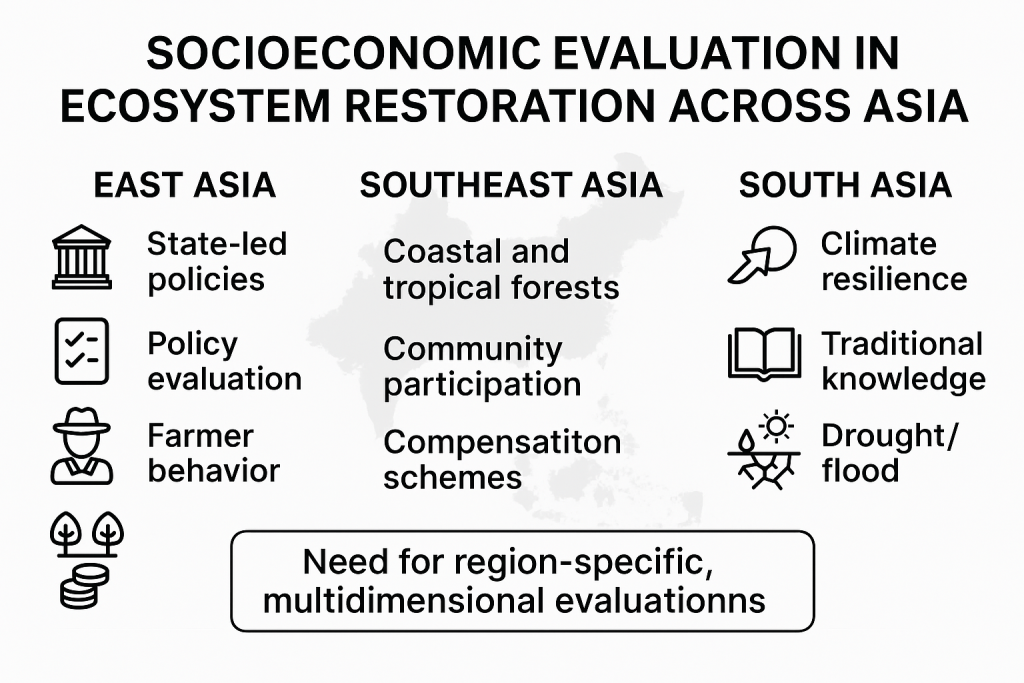
Although few cases incorporate socioeconomic evaluations relative to those focusing solely on biophysical outcomes, the presence of such evaluations across all three subregions highlights their growing significance. In East Asia, attention is focused on large-scale land use management, forest governance systems and the restoration of urban green spaces. In Southeast Asia, evaluations centre on coastal ecosystems and tropical forests, emphasising the integration of disaster risk reduction and government compensation mechanisms. In South Asia, ecosystem restoration is regarded as essential for enhancing disaster resilience, particularly in the context of floods, droughts and sea-level rise caused by climate change (Figure 5).
The initial search database exhibited a heavy geographical skew, with China accounting for approximately 68% of the 495 biophysical articles. This stark concentration is primarily driven by massive state financial investments into national ecological engineering frameworks (e.g., the Sloping Land Conversion Program). However, a highly revealing pattern of shifting emerged during the second full-text screening phase, in which the proportion of Chinese studies contracted sharply in the final 65-paper socioeconomic pool. This quantitative divergence underscores a critical regional integration gap: while ER research in China excels at generating high-resolution biophysical metrics (such as NDVI time-series or soil runoff modules), it structurally isolates these data from empirical, household-level socioeconomic evaluations.
4. CONCLUSION
4.1. Evaluation frameworks and limitations
In this study, an evaluation framework based on ER cases from China, Mongolia and Japan is proposed, and ER evaluation cases from 26 Asian countries are reviewed using this framework. In conclusion, while the fundamental goals of ecosystem restoration are shared across Asia, the approach towards socioeconomic evaluation diverges significantly depending on the regional context. In East Asia, evaluations emphasise multi-scalar land use and policy analysis; in Southeast Asia, the focus lies on the socioeconomic stability of communities dependent on natural resources; and in South Asia, ecosystem restoration is assessed through the lens of climate resilience and disaster risk management. These distinctions highlight the need for context-specific, multidimensional evaluation frameworks for future ER projects across the region.
Beyond regional imbalances, this study highlights a profound systemic limitation regarding the temporal scales of current ecosystem restoration (ER) evaluations. Our structured review reveals that the vast majority of existing studies rely on short-term monitoring windows, often limited to 5 to 10 years post-implementation. Such narrow temporal horizons fail to account for the substantial biophysical and socioeconomic lag phases inherent in socioecological systems.
While primary biophysical indicators, such as initial sapling survival rates or short-term vegetation greening (NDVI), frequently exhibit rapid spikes within the first 3 years, they do not guarantee long-term system recovery. True socioecological resilience exhibits a much more prolonged lag phase (Jones et al., 2018). Crucial long-term trajectories, including deep groundwater recharge, structural soil organic matter recovery, and household income stabilisation that is truly independent of state-led subsidy programs, require decades to materialise. Consequently, evaluating project outcomes prematurely creates a high risk of inflated “perceived success rates” (Abelson et al., 2020) that may ultimately collapse over longer horizons. If monitoring ceases before these lag phases are resolved, the underlying, chronic vulnerabilities of rural communities remain dangerously hidden.
A primary methodological boundary of this study is its reliance on a single publisher’s database for the structured literature review. While ScienceDirect hosts a highly concentrated pool of top-tier international environmental and sustainability journals, this targeted search pipeline inevitably omitted peer-reviewed literature published by other major houses (e.g., Springer, Wiley, Taylor & Francis) as well as non-indexed, domestic regional journals across Asia. Consequently, our dataset potentially under-represents localised grey literature, community-level NGO technical reports and non-English domestic publications. Future research should leverage broader citation indexing databases, such as Scopus and Web of Science, to cross-validate and extend the geographical and institutional scope of the synthesis.
4.2. Implications
By mapping omitted domains into our framework, we transition from a descriptive summary of the literature to a diagnostic assessment of structural evaluation voids. A poignant example is Mongolia: despite facing severe climate-induced desertification risks, the initial database returned only three biophysical studies, none of which transitioned into the final socioeconomic evaluation pool. This complete lack of human-centric monitoring represents a dangerous blind spot that obscures the changing livelihood security and adaptive constraints of nomadic pastoralists under intense environmental stress. Our framework exposes these precise localised voids, providing funding agencies with a clear roadmap of where targeted socioecological research is most urgently required.
The evaluation periods and climate-related indicators could not be sufficiently extracted because numerous cases have been monitored for only several years to a decade since the implementation of ER, and long-term changes were evaluated in only a few cases. Establishing a long-term, sustainable monitoring system poses a future challenge. Based on these findings, this study offers three concrete, actionable policy and practical recommendations to enhance the design, funding and monitoring of future ecosystem restoration (ER) programs across Asia:
1. Tailor funding criteria to regional contexts: International funding bodies and regional networks should move away from mandating standardised, one-size-fits-all evaluation checklists. Instead, funding criteria should be context-sensitive; for instance, requiring East Asian projects to systematically incorporate more household-level social equity proxies to balance their top-down nature, while allowing South Asian projects to prioritise traditional adaptive capacity and climate-risk mitigation metrics.
2. Mandate post-intervention monitoring: To mitigate the distorting effects of post-restoration lag phases identified in our analysis, international funding bodies and regional networks must institutionalise long-term auditing mechanisms. We propose an actionable institutional rule: future ER project approvals should legally secure a dedicated proportion of their total project budget exclusively as a sequestered Phase 2 auditing fund. This fund must be strictly earmarked for secondary socioeconomic and climate-resilience evaluations conducted 10–15 years post-implementation, ensuring that long-term resilience trajectories are fully captured after initial project closure.
3. Bridge the biophysical-socioeconomic data divide: Government agencies implementing environmental engineering must co-design data collection frameworks in close collaboration with social scientists. This ensures that household economic survey tracks are spatially gridded and synchronised alongside remote sensing and ecological monitoring plots, thereby enabling true multidimensional and socioecological evaluation.
These additions ground our regional framework in pragmatic, real-world applications, ensuring that ER initiatives can effectively foster long-term rural resilience.
5. ACKNOWLEDGEMENTS
This research was funded by the Asian Pacific Network for Global Change Research APN, grant number CRRP2022-02MY-Shoyama.