

The perceptions of smallholder farmers to climate change and their responses through nature-based solutions in Northern Vietnam
Keywords
Climate resilience · Nature-based solutions · Northern Vietnam · Perceptions of climate change · Smallholder farmers
HIGHLIGHTS
- Community views on climate change correspond with observed weather patterns.
- Small farmers adopt NbS-aligned practices, including agroforestry and water saving.
- Many NbS stem from traditional knowledge rather than formal policies or frameworks.
1. INTRODUCTION
Climate change is exerting unprecedented pressure on smallholder agricultural systems worldwide, with developing countries facing disproportionate impacts due to their dependence on natural resources for livelihoods (Amani et al., 2022; IPCC, 2022; Momand et al., 2024). In tropical and subtropical regions, smallholder farmers manage the majority of agricultural land and are central to food production systems, yet they remain among the most vulnerable to climate risks. This vulnerability is intensified by limited adaptive capacity, socioeconomic marginalisation and heavy reliance on rain-fed agriculture (Cohn et al., 2017; Morton, 2007). In Asia, small farms contribute over 90% of the region’s food supply, underscoring their critical role in food security (Samberg et al., 2016). However, they are increasingly threatened by erratic weather patterns, rising temperatures and a higher frequency of climate-related hazards such as droughts, floods and storms (Cohn et al., 2017).
Vietnam, one of the world’s most climate-vulnerable nations (Dasgupta et al., 2007; World Bank, 2022), exemplifies these challenges. The Northern Mountainous Region (NMR) is home to a high concentration of ethnic minority communities and is characterised by steep, fragile terrain, which is particularly exposed to climate-induced risks. These include prolonged droughts, unpredictable rainfall, soil degradation and landslides (MONRE, 2021; Son & Kingsbury, 2020). Smallholder farmers in the NMR often rely on traditional agricultural systems such as terracing, shifting cultivation and agroforestry, which are closely tied to Indigenous knowledge and local environmental conditions. However, limited access to infrastructure, extension services, markets and climate information constrains their ability to adapt effectively (Son et al., 2023).
In this context, Nature-based Solutions (NbS) are gaining attention as cost-effective, locally relevant strategies that enhance resilience while restoring ecosystem functions (Chausson et al., 2020; Lupp et al., 2021; Turner et al., 2022). NbS refer to actions that protect, restore, or sustainably manage ecosystems to address societal challenges (IUCN, 2020).
This concept moves beyond conventional, single-objective interventions by emphasising the multifunctionality of ecosystems and the need to harness ecological processes such as carbon sequestration, nutrient cycling, water regulation and habitat provision, to generate multiple co-benefits. NbS are rooted in the ecosystem services framework and the concept of social-ecological systems, recognising that human societies and natural systems are deeply interconnected. As such, NbS not only aim to enhance ecological integrity and climate resilience but also to improve livelihoods, particularly for vulnerable and resource-dependent communities.
The operationalisation of NbS is guided by a set of principles articulated by the International Union for Conservation of Nature, which emphasise addressing clearly defined societal challenges, ensuring net gains for biodiversity, and maintaining economic viability over the long term (IUCN, 2020). A key feature of NbS is the explicit consideration of trade-offs among competing land-use objectives, ensuring that short-term gains do not undermine long-term sustainability. These principles distinguish NbS from conventional environmental management approaches by embedding ecological, social and economic dimensions into a unified framework.
In upland Vietnam, these are not entirely new concepts; long-standing farming practices such as agroforestry, intercropping, terracing, soil mulching and watershed protection are all forms of NbS. NbS approaches such as agroforestry, intercropping, soil and water conservation, and forest stewardship align closely with many traditional and Indigenous practices and offer significant potential for climate adaptation in upland Vietnam (Son et al., 2023).
Vietnam has introduced several policies to promote ecological agriculture and climate resilience, including its National Climate Change Strategy (2022) and commitment to net-zero emissions by 2050. However, adaptation efforts have been uneven, with coastal and urban areas receiving greater investment, while mountainous and ethnic minority regions remain underserved (World Bank, 2022). Additionally, low levels of awareness and understanding of climate change and NbS among upland communities present a major barrier to inclusive and effective adaptation (Simelton et al., 2021).
Understanding how smallholder farmers perceive climate change and engage with NbS is essential for designing adaptation strategies that are both locally grounded and policy-relevant (Ramírez-Agudelo et al., 2022; Nyang’au et al., 2021). Farmers’ perceptions of climate impacts and their trust in adaptation practices strongly influence their willingness to adopt new technologies and strategies (Ayal & Filho, 2017; Belay et al., 2022). Despite the importance of this linkage, research at the intersection of climate perception and NbS adoption among ethnic minorities in northern Vietnam remains limited (Nguyen et al., 2024; Simelton et al., 2021).
This study addresses this critical gap by examining climate perceptions and the uptake of NbS among smallholder farmers in Thai Nguyen and Son La provinces in the NMR of Vietnam. By comparing farmers’ awareness, perceived climate impacts and adaptation responses, the study aims to enhance the understanding of locally led climate action and inform efforts to mainstream NbS into regional development and climate adaptation policy in Vietnam and the wider Asia-Pacific region.
This study is guided by a perception–adaptation–adoption framework, which posits that farmers’ observations and interpretations of climate risks shape their adaptation decisions, including the uptake of NbS. Perception influences risk appraisal, which, in turn, affects behavioural responses and the likelihood of adopting ecosystem-based practices.
2. METHODOLOGY
2.1. Study area
This study was conducted in the Northern Mountainous Region (NMR) of Vietnam, focusing on two districts: Dong Hy in Thai Nguyen province and Van Ho in Son La province (Figure 1). These areas represent distinct socioecological systems and are home to diverse ethnic minority communities, including the Hmong, Thai, Tay, Dao, Muong and Nung (Son et al., 2023). Agriculture forms the backbone of local livelihoods, making these communities highly vulnerable to climate change impacts such as droughts, floods and erratic weather patterns (Son & Kingsbury, 2020).
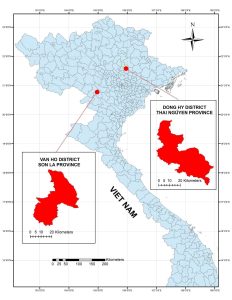
Dong Hy, located in northeastern Vietnam, spans approximately 431.73 km2 and is home to about 1.335.987 people (Thai Nguyen Province Statistic Yearbook, 2023). The district’s varied topography (200–500 meters above sea level) and tropical monsoon climate support a mix of tea cultivation, subsistence farming, and forest plantation. The area’s ethnic diversity and dependence on natural resources make it a relevant site for exploring perceptions of and responses to NbS.
Van Ho, a highland district in Son La province, covers nearly 979.8 km2 with elevations ranging from 800 to 1000 m. It is inhabited by about 58,790 people, primarily from ethnic minority groups (Son La Province Statistic Yearbook, 2023). With a subtropical climate, Van Ho’s economy is centred on agriculture, particularly agroforestry and sustainable land-use practices (Table 1). Its environmental and socioeconomic conditions make Van Ho a critical site for investigating locally driven climate adaptation through NbS.
| Characteristics | Dong Hy District (Thai Nguyen) | Van Ho District (Son La) |
|---|---|---|
| Total area | ∼431.73 km2 | ∼979.8 km2 |
| Population | 1,335,987 | 58.790 |
| Main ethnic groups | Kinh (63%), Nùng (13%), Tày (2.5%), Dao (4.5%), Hmong (1.5%) | Thai (41%), Hmong (21%), Muong (22%), Dao (14%) |
| Topography | Low to highland (200–500 m a.s.l.) | Mountainous (800–1000 m a.s.l.) |
| Main livelihoods | Tea cultivation, subsistence farming | Upland farming, agroforestry, livestock |
| Climate hazards | Droughts, flash floods, erratic rainfall | Prolonged droughts, landslides and unpredictable rainfall |
| Source: Thai Nguyen Province Statistic Yearbook (2023); Son La Province Statistic Yearbook (2023). | ||
Over the past three decades, both Thai Nguyen and Son La provinces have experienced significant warming, consistent with national and regional climate trends. In Thai Nguyen, located in Vietnam’s northeastern uplands, average annual temperatures increased by approximately 0.8 °C between 1990 and 2022 (Thai Nguyen Meteorology and Hydrology Department, 2023). The number of days exceeding 35 °C has grown markedly, intensifying heat stress on crops and people. Similarly, Son La province, characterised by mountainous terrain, has recorded an average temperature rise of around 1.0 °C over the same period, with more pronounced warming at higher elevations in districts such as Van Ho (Son La Meteorology and Hydrology Department, 2023). The province has also seen a notable increase in temperatures and negative impacts on agricultural production (MONRE, 2021, 2023).
2.2. Data collection
A mixed-methods approach was adopted to ensure both breadth and depth in understanding climate change perceptions and NbS adoption among smallholder farmers (Grenier, 1998).
From March to August 2024, a structured questionnaire survey was administered to a total of 200 households, 100 in Dong Hy (Thai Nguyen) and 100 in Van Ho (Son La), using systematic random sampling. Within each village, a household list was obtained from the commune authorities. Every fifth household was selected using a random starting number.
Sampling ensured representation across socioeconomic status, gender, age, education and landholding size. The survey focused on perceptions of climate change impacts, awareness and understanding of NbS, and adoption behaviours and barriers to implementation. The questionnaire measured variables including: climate perception indices (temperature, rainfall and extreme events), livelihood impacts, adaptation strategies, awareness of NbS, frequency of NbS practice adoption, institutional support and socio-demographics. The questionnaire was pre-tested with fifteen households. Cronbach’s alpha for perception and adaptation indices ranged from 0.72 to 0.81, indicating acceptable internal consistency.
In addition, we used participatory rural appraisal (PRA) techniques, key informant interviews (KIIs) (n = 10), focus group discussions (FGDs) (n = 5) and direct field observations to understand climate change impacts and adaptation strategies. We selected key informants from diverse institutions, including chairpersons of the commune and village, the Dong Rung cooperative and the Farmers’ Association. FGDs triangulated information gathered from the KIIs and field observations. This helped us to collect information on household and community adaptation strategies in the study areas. In addition, field observations included the impacts of climate change on agriculture, livestock farming and the local economy and examined different adaptation strategies adopted in these sectors. All interviews and FGDs were conducted in private, recorded with consent and transcribed for analysis. The qualitative component helped capture nuanced community perspectives and culturally embedded responses to climate risks. Additionally, secondary information was gathered from peer-reviewed journal articles and relevant documents from different organisations to understand their activities on climate change adaptation.
2.3. Data analysis
Survey data were analysed using descriptive statistics (frequencies, means and percentages) in SPSS to examine trends in climate perceptions and NbS adoption.
Qualitative data from interviews and FGDs were analysed using thematic analysis, following Clarke and Braun’s (2017) six-step framework. NVivo 12 was used to facilitate data coding and management. The analysis was guided by Creswell’s (2013) and Attride-Stirling’s (2001) frameworks to identify and interpret key themes related to climate change perceptions, local knowledge and practices, barriers and enablers of NbS adoption, and community adaptation strategies. The thematic coding process ensured rigorous interpretation of farmers’ lived experiences and contextual understanding of the potential of NbS at each site.
3. RESULTS AND DISCUSSION
3.1. Household characteristics
The average household size was 4.6 persons, with a slightly higher mean in Van Ho (4.9) compared to Dong Hy (4.3). A majority of respondents (58%) were male and 42% were female. Most respondents were between 35 and 60 years old, and 68% had completed primary or lower-secondary education.
Agriculture was the dominant livelihood activity (95% of households), with a small percentage (8%) reporting supplemental income from wage labour, small trading or handicrafts. The average landholding size was 0.6 ha in Dong Hy and 0.8 ha in Van Ho. In Van Ho, households were more likely to practice mixed agroforestry systems, while monoculture tea cultivation was common in Dong Hy. This data is shown in Table 2.
| Household characteristics | Dong Hy (n = 100) | Van Ho (n = 100) | Total (n = 200) |
|---|---|---|---|
| Average household size | 4.3 persons | 4.9 persons | 4.6 persons |
| Gender of respondents | |||
| Male | 60% | 56% | 58% |
| Female | 40% | 44% | 42% |
| Age range of respondents | 35–60 years (majority) | 35–60 years (majority) | 35–60 years (majority) |
| Educational attainment | |||
| Primary or lower secondary | 65% | 71% | 68% |
| Primary livelihood activity | |||
| Agriculture | 96% | 94% | 95% |
| Supplemental income | 10% | 6% | 8% |
| Average landholding size | 0.6 ha | 0.8 ha | 0.7 ha |
| Source: Field data collection. | |||
3.2. Perceptions of climate change
A large majority of surveyed households (92%) reported direct experiences of climate-related changes over the past decade, reflecting a strong local awareness of environmental transformation. The most frequently perceived impacts included rising average temperatures (94%), increasingly unpredictable rainfall (85%), and more frequent and prolonged droughts (81%). Additionally, 84% of respondents reported experiencing floods and landslides, while 80% observed declining crop yields attributed to weather-related stressors. These perceptions mirror broader climatic trends in northern Vietnam’s upland regions, where intensifying variability in temperature and precipitation is placing mounting pressure on smallholder agricultural systems (Chen et al., 2024).
Spatial differences emerged between the two study sites. In Van Ho, respondents more often identified landslides and extended dry seasons as primary stressors, while in Dong Hy, intense rainfall events were more frequently reported. A Hmong farmer from Van Ho described the growing uncertainty:
“The seasons are no longer the same. Rain comes when we are planting or harvesting and our maise is often destroyed.” (Semi-structured interview).
These subjective observations were supported by analysis of long-term meteorological data (1990–2023). Linear regression revealed a statistically significant increase in mean annual temperature (p < 0.05) in both districts. Furthermore, precipitation patterns showed greater inter-annual variability, reinforcing local narratives of disrupted seasonal cycles and increased risk. Together, these findings highlight the urgent need for locally tailored climate adaptation strategies, particularly those grounded in NbS and traditional knowledge.
Community perceptions of climate change in northern Vietnam align closely with observed meteorological data. Local farmers, in particular, have demonstrated a strong observational capacity, reporting changes such as rising temperatures, erratic rainfall, shorter winters and more frequent extreme weather events that are corroborated by regional climate records. These shared observations indicate that traditional knowledge remains a vital and credible source of climate information at the grassroots level (Son et al., 2019; Berkes, 2017).
In response to these uncertainties, smallholder farmers are adopting a range of adaptive behaviours. Practices such as crop diversification, intercropping and agroforestry have gained importance. These strategies help buffer against climate-induced losses by reducing dependence on single crop types and by preserving locally adapted seed varieties. Such grassroots adaptations are typically low-cost, knowledge-based and ecologically sound, aligning closely with the principles of NbS (Cohen-Shacham et al., 2016).
Moreover, recognising and integrating these community-driven strategies into broader climate adaptation frameworks may enhance the scalability and sustainability of NbS. As Carl et al. (2021) suggest, adaptive responses that are dynamic, context-specific and culturally grounded are more likely to succeed in the long term.
The accuracy of farmers’ climate perceptions in both districts mirrors findings from Ethiopia (Ayal & Filho, 2017) and Kenya (Nyang’au et al., 2021), where smallholder observations closely tracked meteorological trends. This reinforces the reliability of local climate knowledge across globally distributed upland agrarian systems.
3.3. Livelihoods impacts and adaptation
Farmers in both Van Ho and Dong Hy districts reported significant disruptions to agricultural productivity and economic stability due to changing weather patterns. In Van Ho, maise and coffee producers experienced yield declines of up to 30% over the past five years, largely attributed to irregular rainfall and prolonged dry spells. In Dong Hy, rice and tea cultivation have become increasingly erratic, with delayed rain and intensified storms disrupting planting and harvesting cycles. Thematic analysis of in-depth interviews highlighted several key livelihood impacts. Income instability was the most commonly cited issue, mentioned in 80% of interviews, with frequent reports of underperforming harvests.
To cope with climate variability, farmers employed a mix of traditional knowledge and modern practices. Adaptation strategies included adjusting planting schedules based on seasonal forecasts, practising terracing and contour farming, particularly widespread in Van Ho, to combat soil erosion, and using mulching, composting, and intercropping to retain soil moisture and improve resilience. In erosion-prone areas, agroforestry and tree planting emerged as long-term solutions.
At both sites, farmers reported that NbS-based practices, especially agroforestry, terracing and diversified cropping, helped stabilise yields, reduce soil erosion and provide supplementary food and income sources. In Van Ho, integrated forest–garden–livestock systems improved household income stability, while in Dong Hy, intercropping in tea plantations reduced production risks associated with erratic rainfall.
3.4. Local knowledge and community adaptation strategies
Thematic analysis of qualitative data revealed a strong reliance on Indigenous and local knowledge as the foundation for climate adaptation among upland farming communities in Van Ho and Dong Hy. Traditional strategies included interpreting environmental cues such as wildlife behaviour and plant phenology as early warning signals, selecting seeds for drought resilience, practising diversified cropping and engaging in community-led watershed management. As a Dao farmer in Dong Hy noted:
“The elders know which trees are good for landslides. We use bamboo and native trees around our farms.”
Such practices reflect deep-rooted ecological literacy and adaptive capacity shaped by generations of experience. The case studies confirm the growing recognition that Indigenous and local knowledge systems are critical to the success of NbS. Practices such as agroforestry, terracing, intercropping and the use of native species are widespread, environmentally sustainable and culturally embedded. This highlights how socio-cultural and institutional factors shape climate responses and NbS implementation (Asrat & Simane, 2018).
Therefore, NbS should be co-developed with communities to ensure their relevance and long-term viability (Cohen-Shacham et al., 2016; Ferreira et al., 2020). In northern Vietnam, where communities have long practised terraced farming, agroforestry and crop diversification, there exists a strong foundation for context-specific, culturally appropriate adaptation strategies. For instance, terraced rice farming not only prevents soil erosion on steep slopes but also retains water. Agroforestry systems integrate trees with crops or livestock, diversifying income and improving soil health, biodiversity and resilience. Crop rotation and intercropping enhance soil fertility and reduce chemical inputs, demonstrating that traditional practices are effective NbS (Iseman & Miralles-Wilhelm, 2021; Johnson et al., 2022).
Qualitative insights showed that although the terminology “NbS” was rarely used, the underlying principles were deeply rooted in cultural norms and intergenerational learning. As one Thai community elder in Van Ho noted:
“We plant trees not because we are told to, but because our elders taught us that forests protect our land.” (FGD, Van Ho).
This underscores the importance of culturally contextualising NbS initiatives to ensure alignment with local values and enhance community ownership (Aniye et al., 2024; Carl et al., 2021; Guo et al., 2021).
To scale these approaches, policymakers should integrate traditional knowledge into climate adaptation planning through participatory frameworks. As Berkes (2017) argues, local communities possess a place-based understanding of climate and ecosystem dynamics, which is critical for building adaptive and resilient responses to climate change.
3.5. Adoption of nature-based solutions
While only 48% of respondents reported familiarity with the term Nature-based Solutions, a substantially higher proportion engaged in activities aligned with NbS principles. This gap highlights a disconnect between formal terminology and local practice, suggesting that many NbS approaches are deeply embedded in traditional ecological knowledge rather than derived from policy or technical frameworks.
In Van Ho District, Son La Province, smallholder farmers are increasingly adopting NbS to enhance climate resilience. Approximately 62% of surveyed households engage in agroforestry systems, such as intercropping fruit trees, like longan and plum, with pineapple or annual crops on sloping land. Around 48% employ integrated forest-garden-livestock models, which combine forest conservation, home gardening and animal husbandry to generate diversified, sustainable livelihoods. Community-led forest restoration is also notable, with about 55% of households participating in activities such as native species planting to stabilise watersheds. Traditional soil and water conservation practices remain widespread. Terracing continues to be used by 68% of households to mitigate runoff and erosion, while 45% practice mulching and maintain vegetative ground cover to enhance soil moisture retention. Approximately 40% implement water conservation measures, including protecting natural springs and rainwater harvesting. With support from non-governmental organisations (NGOs), about 35% of households have adopted eco-livelihood models, ranging from circular agriculture and organic farming to community-based ecotourism.
In Dong Hy District, Thai Nguyen Province, smallholder farmers also apply NbS, though adoption rates are generally lower than in Van Ho. Agroforestry systems, such as tea interplanted with acacia or cassia trees, are used by approximately 38% of households to improve soil fertility and structure. About 32% practice intercropping legumes with maise for soil enrichment, while 36% have begun using drought-tolerant maise varieties as part of improved cropping systems. Soil and water conservation practices include the use of grass strips and contour hedgerows (30%) and organic composting techniques (25%). Additionally, 41% of households maintain mixed-use homegardens, contributing to food security and income diversification through the cultivation of fruits, herbs and vegetables.
Comparatively higher adoption rates in Van Ho can be attributed to stronger cooperative networks and more targeted support from NGO-led interventions. As one Muong farmer in Van Ho observed:
“Without support from the agroforestry project, I wouldn’t have known how to mix trees with maise.”
This underscores the critical role of community-based technical assistance tailored to specific socioecological contexts (Seddon et al., 2020). Enhancing the visibility and recognition of these locally rooted NbS practices can bridge the gap between traditional knowledge and formal climate adaptation strategies.
Unlike most NbS adoption studies, which focus on single sites, this study provides a comparative perspective across two socioecological contexts. The contrast between Van Ho’s stronger cooperative networks and Dong Hy’s market-driven systems offers insight into how institutional environments shape NbS uptake.
3.6. Barriers to nature-based solutions adoption
Multiple barriers continue to constrain broader uptake. In Van Ho, limited technical knowledge (68%) and labour shortages (32%) were the most significant barriers. Farmers expressed difficulty in managing multi-strata agroforestry systems without expert support. In Dong Hy, financial constraints (57%) and market insecurity (24%) were the main barriers, especially for tea–tree intercropping systems. Across both sites, inadequate extension services and limited access to seedlings or inputs hindered scaling.
In both districts, while many households already engage in NbS-aligned practices, broader adoption remains hindered by systemic socioeconomic and institutional barriers. In Dong Hy, these include environmental degradation, low local capacity and weak policy incentives. These challenges underscore the uneven distribution of enabling conditions and the importance of targeted interventions that consider both biophysical and governance contexts.
The observed disparities between the two sites affirm the critical role of institutional support and policy environments in facilitating NbS adoption (Solheim et al., 2021). Access to agricultural cooperatives and extension services in this study was strongly correlated with higher adoption rates, reinforcing the importance of institutional intermediaries in bridging the gap between policy and practice.
To support wider NbS implementation, investments should prioritise inclusive extension services, farmer-to-farmer learning platforms and co-production processes involving communities, scientists and policymakers (Giordano et al., 2020; Smith et al., 2021). While Vietnam’s national strategies, such as the National Climate Change Strategy (MONRE, 2023), increasingly emphasise that successful implementation of NbS requires addressing systemic challenges, promoting inclusive participation and supporting community-led leadership in adaptation planning and action.
Overall, the findings reaffirm global evidence that NbS adoption is most successful when rooted in Indigenous systems and supported by strong local institutions. The Vietnamese case adds nuance by demonstrating how ethnic minority communities interpret climate risks and mobilise traditional practices that closely align with international NbS frameworks.
4. CONCLUSIONS
This study highlights that farmers are acutely aware of the impacts of climate change, including erratic rainfall, prolonged droughts, flash floods, and temperature extremes, all of which pose serious threats to agricultural productivity and local livelihoods.
Many farmers are actively adopting adaptation strategies such as agroforestry, terracing, intercropping, composting and water conservation that align with the principles of NbS. These practices not only help mitigate environmental risks but also contribute to improving soil health, conserving biodiversity and enhancing ecosystem services. Importantly, the study found that traditional knowledge and cultural practices play a significant role in shaping these locally adapted solutions.
The study identifies limited technical knowledge, financial constraints and weak institutional support as the primary constraints to NbS adoption, though their severity varies by site; specifically, technical capacity in Van Ho and financial accessibility in Dong Hy.
To enhance the effectiveness and uptake of NbS among smallholder farmers, there is a need for more inclusive and participatory approaches to policymaking and programme implementation. This includes strengthening extension services, improving access to resources and fostering community-led innovation.
This study contributes novel comparative insights from two upland ethnic minority districts in Vietnam, linking farmers’ climate perceptions with their adoption of NbS grounded in Indigenous knowledge. By quantifying NbS uptake and identifying site-specific barriers, the research advances understanding of how culturally embedded practices intersect with formal climate adaptation frameworks.
Policy implications include the need for targeted extension services, financial incentives for agroforestry and soil conservation, improved access to climate information and integration of Indigenous knowledge into provincial climate adaptation planning.
Future research should examine long-term socioecological outcomes of NbS, assess gendered adoption patterns and evaluate participatory co-design models to support community-led scaling.
5. ACKNOWLEDGEMENT
This work was conducted as part of the research programme at Thai Nguyen University of Agriculture and Forestry. Research was supported by the Asia-Pacific Network for Global Change Research through a project to Ho Ngoc Son, under Grant No. CBA2022-08MY-Ho Ngoc.