
The value chain analysis of PVC recycling in Pakistan: Challenges and opportunities for sustainable resource management
Keywords
Circular economy · Plastic waste · PVC recycling · Sustainable development · Value chain
HIGHLIGHTS
- Valuable insights into opportunities within the PVC value chain in Pakistan.
- Critical barriers hindering PVC circularity include regulatory disparities.
- Enabling factors, such as a collaborative approach, can improve PVC circulatory.
- This study suggests pathways for PVC circularity and green business opportunities.
1. INTRODUCTION
Plastics have become indispensable materials due to their versatility, durability and widespread applications across domestic, commercial and industrial sectors (Milios et al., 2018). Yet, the prevailing linear economic model of production, consumption and disposal has resulted in mounting environmental and human health risks. Over the past three decades, global plastic consumption has increased nearly fourfold, with production reaching approximately 460 million tonnes between 2000 and 2019 (OECD, 2022). Despite this rapid growth, only 9% of plastics are recycled, whereas 22% remain mismanaged and leak into the environment (OECD, 2022). Each year, an estimated 14 million tonnes of plastic waste enter the world’s oceans, exacerbating ecological degradation and public health challenges (Geneva Environment Network, 2022; IUCN, 2021).
Growing recognition of these challenges has led to global momentum toward a circular economy, which aims to minimise waste by rethinking product design, enhancing resource efficiency, and promoting reuse and recycling (Johansen et al., 2022; Kirchherr et al., 2017). Transitioning to such a system requires a comprehensive understanding of the plastic value chain, as circularity interventions must be grounded in evidence-based insights spanning design, manufacturing, consumption, waste collection, and end-of-life management (Capetillo et al., 2022; Blomsma & Brennan, 2017). Approaches such as waste value chain analysis and material flow analysis (MFA) are increasingly used to map resource flows, identify leakage points and inform circular policy strategies (Iacovidou et al., 2017; Rigamonti et al., 2020).
Existing literature has examined how recycling systems evolve across different countries and waste streams (Freegard, 2023; Matter et al., 2015; Nielsen et al., 2019), highlighting diverse barriers including inadequate waste collection infrastructure, limited public–private cooperation and the fragmented role of the informal sector (Aslam et al., 2021; European Environment Agency, 2021; Nawaz et al., 2021). Industries also face constraints, including limited availability of high-quality recycled feedstock (Milios et al., 2018), cost pressures and insufficient policy incentives (Söderholm & Ekvall, 2019).
Conversely, several enablers support circularity transitions. These include strong regulatory frameworks, rising public awareness (Hart et al., 2019; Tura et al., 2019), improved recycling infrastructure (Kushwah et al., 2023; Pedersen & Manhice, 2020), innovation-led research and development (UNEP, 2023b), and robust markets for secondary materials (European Commission, 2018; Van der Vegt et al., 2022). Global policy developments, such as the EU Circular Economy Action Plan, Extended Producer Responsibility (EPR) schemes, and the UN Global Plastics Treaty negotiations, provide important benchmarks for designing effective plastic circularity strategies (European Commission, 2020; UNEP, 2023a).
Despite these advancements, research specifically addressing polymer-level circularity, especially for PVC, is limited, even though PVC presents unique chemical, technical and regulatory challenges compared to other polymers (Stahel, 2016; Turner, 2018). Internationally, studies have analysed PVC recycling technologies, additive management and circular design considerations (Hahladakis et al., 2018), but such insights remain scarce in developing-country contexts. Furthermore, Milios et al. (2018) noted that existing studies seldom provide a holistic understanding of the plastics value chain—from waste generation to the transformation of recyclates into new products. Van der Vegt et al. (2022) further emphasised that the literature disproportionately focuses on barriers while neglecting system-level enablers.
In Pakistan, there is a significant lack of evidence-based knowledge on improving the circularity and resource efficiency of plastic, particularly PVC, despite the PVC sector growing at an annual rate of nearly 6% and accounting for around 70% of its use in construction and development (Engro, 2023). Responding to these gaps, this study offers the first in-depth analysis of the PVC value chain in Pakistan, mapping barriers and enablers across each actor and stage of the value chain. Given the limited polymer-specific knowledge among local stakeholders, understanding PVC’s circularity potential is essential for informing future policy, guiding industry practices and aligning Pakistan’s waste management priorities with global circular economy benchmarks. This research thus contributes new evidence to an underexplored sector and supports ongoing efforts to strengthen plastic recycling systems in emerging economies. This study addresses this critical gap by providing the first comprehensive assessment of the PVC value chain in Pakistan, examining key factors influencing PVC recycling, industry-level challenges and the barriers hindering effective waste sorting and reprocessing. Furthermore, it identifies potential enabling conditions that could strengthen national waste recycling and management strategies. The novelty of this study lies in generating baseline data and insights specific to Pakistan’s PVC industry, an area with virtually no prior research, to support informed policymaking and stimulate future investigations in this underexplored sector.
2. METHODOLOGY
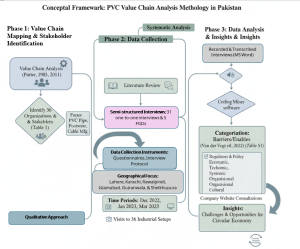
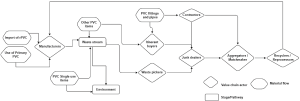
Our study follows well-established MFA (Ghani, 2021; Hsu et al., 2022) and value chain analysis (VCA) (Fearne & Martinez, 2012; ILO, 2023; Jaligot et al., 2016) frameworks (Figure 1). Across the value chain of PVC, we investigate enablers and barriers for PVC circularity. We define “barriers” as factors that constrain market development and “enablers” as conditions that enhance the recycling and upscaling of plastic waste through aligned design, economic, regulatory and socio-technical factors (Siltaloppi & Jähi, 2021; Van der Vegt et al., 2022).
We explicitly exclude barriers and enablers associated with imports, exports or stakeholders outside the national context from the system boundary, given Pakistan’s low exports of waste and scrap.
We conducted a value chain analysis using a qualitative approach to map the network of organisations and stakeholders (Table 1) involved in transforming primary and secondary PVC, both domestic and imported, into end products (Figure 1), following the methodology proposed by Porter (1985, 2011). Recognising that individual organisations typically have visibility only over their immediate suppliers or customers, we applied this approach to trace the broader sequence of activities. Through this analysis, we identified 36 organisations that actively shape the PVC waste market in Pakistan and elucidated the series of interlinked activities that underpin its functioning.
| City name | Sub-sectors | Value chain category |
|---|---|---|
| Islamabad/Rawalpindi | Shoe factories, PVC panels, foam boards | Sorting (3) Production (4) Compounding (4) Consumption (3) Recycling (2) |
| Lahore | Shoe factories, PVC pipes, cable manufacturers, Rigid sheets, distributors, importers | Importing (2) Distribution (1) Sorting (3) Production (3) Compounding (3) Consumption (3) Recycling (3) |
| Sheikhupura | PVC pipes | Recycling (1) |
| Gujrat | PVC Pipes | Production (1) Compounding (1) Consumption (1) Recycling (1) |
Once we identified the relevant organisations and key informants, we employed a combination of qualitative research instruments, including a literature review, semi-structured in-person interviews and focus group discussions (FGDs) to collect data. We visited a total of 36 units within the PVC industry, where we interviewed owners and other relevant personnel regarding multiple aspects of PVC manufacturing and recycling. Of these, 31 were one-to-one interviews and 5 were FGDs. We focused on key sectors including PVC pipe production, footwear and cable manufacturing, and conducted data collection over three periods: 5–9 December 2022, 2–11 January 2023 and 25 March 2023. Geographically, we focused on five major cities in Pakistan that serve as waste hubs: Lahore, Karachi, Rawalpindi/Islamabad, Gujranwala and Sheikhupura. We conducted interviews and FGDs using semi-structured questionnaires and protocols to gather information on limitations, barriers, enablers and industry demand for recycled PVC (r-PVC) Following the group interviews and one-to-one interviews, we conducted visits to PVC industrial setups involved in manufacturing and recycling. We also consulted the websites of the companies included in the group interviews to gain additional insights into their manufacturing processes, recycling practices, and the composition of different PVC products.
To analyse the data, we followed a systematic approach. We recorded all interviews and group discussions and subsequently transcribed them using MS Word. We then coded the transcripts using QDA Miner software, categorising barriers and enablers according to their respective positions in the value chain, following the framework proposed by Van der Vegt et al. (2022) (Table S1). This framework identifies a range of factors, including regulatory and policy, economic, technical, systemic, organisational and cultural, and classifies each as a barrier or enabler while situating it within the value chain. By analysing these factors, we gained valuable insights into the challenges and opportunities within the PVC value chain, highlighting areas where targeted interventions could support the development of a circular economy.
3. RESULTS AND DISCUSSION
We present the findings from FGDs/interviews conducted with key stakeholders within the PVC value chain. The existing literature has highlighted several challenges associated with enhancing plastic recycling, including technological, regulatory and market-related obstacles (Allison et al., 2021). Particularly notable in the context of market-related issues are concerns, i.e., those linked to recycling and transportation, along with a deficiency in demand for recycled plastic, which pose complexities in cost justification. The PVC value chain, like other material streams, is intricate and does not conform to a single “one-size-fits-all” market characterisation. Consequently, we adopt a ‘category-specific’ and “sub-market” perspective for our analysis as suggested by Van der Vegt et al. (2022) and Milios et al. (2018), respectively, identifying category-specific distinct concerns and opportunities within sub-markets for detailed exploration (Table 2).
| Category | Enablers/Barriers | Enabler | Barrier | Sourcing of materials | Manufacturing | Sale | Usage | Collection | Sorting | Remanufacturing |
|---|---|---|---|---|---|---|---|---|---|---|
| Regulations and policy factors | Regulatory/policy disarray | X | ||||||||
| Public awareness | X | X | ||||||||
| Limited to the non-implementation of waste regulations | X | |||||||||
| Lack of product and recycling standards for r-PVC | X | |||||||||
| Low market demand for specific PVC products | X | |||||||||
| Substandard PVC products are produced due to low standards | X | |||||||||
| Economic factors | High recycling costs | X | ||||||||
| Economic potential of recyclate | X | |||||||||
| Reclamation costs of single-use PV | X | X | ||||||||
| Remanufacturing of products using r-PVC | X | |||||||||
| Labour/fuel costs | X | |||||||||
| Tradeoffs in using primary PVC | X | X | ||||||||
| Growing demand from existing markets | X | X | ||||||||
| Technical factors | Unknown composition of r-PVC | X | ||||||||
| Control over market price and product quality | X | |||||||||
| Design/specifications and mechanical performance of PVC products | X | X | ||||||||
| Systematic factors | Lack of infrastructure & economics for sorting | X | ||||||||
| Comingled collection | X | |||||||||
| Testing facilities | X | |||||||||
| Research and development | X | |||||||||
| Use of prohibited plasticisers by local manufacturers | X | |||||||||
| Post-consumer PVC waste handling and management | X | X |
3.1. Regulatory and policy factors
Table 3 highlights the regulatory barriers and enablers for PVC circularity in Pakistan. Our analysis identifies several regulatory barriers and enablers impacting PVC circularity in Pakistan. Our analysis shows that manufacturers believe high-income consumers are reluctant to accept products containing recyclate, often perceiving them as intended for lower-income groups and as low quality. This perception is compounded by skepticism regarding the quality of r-PVC products, leading many producers to withhold compositional information from customers. Some interviewees noted that a small niche of sustainability-conscious consumers demanding circular products exists; however, this segment remains limited and is not their target customer market. Our findings suggest a missed opportunity for the Pakistani PVC industry, as high-income consumers currently show low acceptance of products containing recyclate. In contrast, literature from other regions indicates that secondary materials are increasingly regarded as premium, often commanding higher prices than primary materials (Grafström, 2025). This trend is reinforced by robust environmental labelling, certification schemes and green procurement policies that actively support circular business practices (Grafström, 2025; Silva et al., 2016), highlighting a potential pathway for market development in Pakistan. Our interviews further reveal that in Pakistan, contaminants such as legacy additives are not considered a significant concern due to weak regulatory oversight. Consequently, PVC waste is readily accepted by private construction contractors and aggregators. This is consistent with accounts of global trade in hazardous plastic and waste (Hui et al., 2025; Liang et al., 2021; Zhu et al., 2023). Manufacturers also highlight that limited awareness and education among both the public and policymakers hinder the industry’s ability to disclose circularity information and promote r-PVC products.
| Barriers | Enabler/opportunities | Collectors/match makers/aggregators | Producers/manufacturer importers |
|---|---|---|---|
| Low acceptance from high-income customers; perception that secondary material products are for low-middle income groups | Niche customer group is conscious of sustainability, although small | X | |
| Skepticism towards product quality and composition of r-PVC | Lack of awareness and education; barriers for the industry to disclose information and promote circular products | X | X |
| Regulatory disparity in managing domestic and imported plastic waste | Techno-economic assessment of the issue | X |
Our analysis shows that the r-PVC scrap ecosystem in Pakistan comprises two distinct supply chains: imported scrap and domestic scrap. These chains face differing perceptions and regulatory treatment from stakeholders, particularly policymakers. We found that while there are effectively no regulations supporting domestic plastic recycling, imports of plastic scrap face some of the country’s strictest policies (Table 3). Our interviews with value chain actors revealed that import duties on plastics and PVC products are approximately 20%, consistent with earlier studies (Thonthia, 2017), validating the accuracy of stakeholder accounts. We noted that PVC resin imports are subject to additional anti-dumping duties ranging from 3.44% to 20.47%, depending on origin and market conditions. The overall tariff on imported plastics and PVC is 17%, covering a wide range of products. Our findings align with the literature, which highlights regulatory bias toward controlling imports rather than supporting domestic recycling (Thonthia, 2017).
3.2. Economic factors
Our analysis indicates that economic factors significantly influence PVC recycling practices in Pakistan, particularly concerning the cost of secondary materials and recycling processes. These costs are subsequently passed down the value chain, potentially increasing manufacturing expenses and the final product price. Table 4 illustrates key characteristics that highlight how economic feasibility affects recycling uptake in the PVC sector.
| Barriers | Enabler/opportunities | Collectors/match makers/aggregators | Producers/manufacturer importers |
|---|---|---|---|
| • Low demand and market value for single-use PVC waste | • Incentivise collection for circularity of PVC products with a low collection rate | X | X |
| • Penalties for not meeting customer demands | — | X | |
| • Fluctuating price index between primary and r-PVC | • Develop and promote green procurement policies to support the recycling industry and to meet targets related to recyclate content | X | X |
| • High energy cost associated with recycling and using r-PVC | • Government to support or incentivise to offset the additional costs associated with using recycled PVC | X |
Our interviews with value chain actors revealed that collectors, including waste pickers, junk dealers, and aggregators, prioritise PVC scrap due to its relatively high selling price. For instance, in January 2023, mixed reclaimed recyclables were sold for 40 Rs/kg, whereas PVC waste fetched 100 Rs/kg. Collectors predominantly trade PVC items such as pipes, shoe soles, containers, casings, automobile parts, utensils and advertising boards. Conversely, PVC packaging and single-use items are rarely reclaimed because they lack market value and collection incentives. These findings align with existing literature highlighting the economic challenges of plastic recycling in Pakistan. Batool et al. (2008) reported that only 21.2% of recyclable waste in Lahore is recycled, generating approximately Rs. 271 million (US$ 4.5 million) annually (Aslam et al., 2022). This underscores the need for cost-effective recycling technologies and improved collection systems to enhance recycling rates. Additionally, Iqbal et al. (2023) and Aslam et al. (2022) emphasised the importance of developing innovative recycling business models tailored to local conditions to strengthen Pakistan’s waste sector and promote circular economy practices.
A variety of perspectives were expressed to indicate which factors create market signals and propositions for collectors to reclaim PVC product waste or items, including labour costs associated with collection and sorting, rising fuel prices, inflation and the primary PVC price affecting plastic waste prices and demand. The literature reports similar concerns that recyclers and manufacturers often face procurement challenges related to the availability and quality of r-PVC feedstock globally (Milios et al., 2018; Schuyler et al., 2022). Addressing these market dynamics requires appropriate responses, such as subsidies, incentives and green procurement policies. While technological solutions play a critical role in advancing the transition to a circular economy, it is equally important to integrate socioeconomic aspects. This was highlighted by Ueda et al. (2003), who emphasised that the decision-making process and actors involved in the collection and processing of used products significantly impact the costs and benefits of recycling for individuals and society as a whole. Similar findings were reported by Aslam (2020), who assessed the challenges faced by a local multi-layer packaging recycler (Green Earth Recycler) in scaling up their operations over the years. These insights underscore the need for a comprehensive approach that considers both technological advancements and socioeconomic factors to drive effective and sustainable recycling practices.
Interestingly, for reprocessors and manufacturers, the fluctuating price index between primary and r-PVC is the most critical barrier. Two discrete reasons emerged from this. First, the main motivation for reprocessors and manufacturers to utilise r-PVC is to cater to customer or population groups with lower purchasing power and to gain a price advantage in the market. Second, the potential cost savings in using r-PVC, which includes the advantages of using pre-existing additives within its composition, though this is more relevant to flexible PVC product manufacturers. For instance, a shoe manufacturer reported that primary PVC shoes cost twice as much to produce compared to shoes made from waste materials. For instance, if primary PVC shoes are priced at 300 rupees, shoes made from waste materials would be around 150 rupees.
Our analysis reveals a persistent sense of apprehension among reprocessors and manufacturers regarding the use of r-PVC. This hesitation is primarily linked to high energy costs, volatile primary PVC prices and increased machinery wear due to additional feedstock preparation steps such as cutting and crushing. We found that electricity fluctuations impose high costs during continuous production, as power outages lead to batch waste and disrupt production flows. To avoid losses, some actors pre-emptively halt machinery before expected outages; however, the absence of reliable load-shedding schedules makes this difficult. Across all actor categories, our findings indicate that price instability in primary PVC undermines the competitiveness of r-PVC. Manufacturers reported frequent instances in which the market price of primary PVC falls below that of recycled PVC, creating a business dilemma. The added processing costs and perceived risks regarding product quality further discourage the use of r-PVC. These findings align with Van der Vegt et al. (2022), who highlight that price volatility heightens investment risk and undermines the competitiveness of recycled materials when the cost gap with virgin plastics becomes unfavourable.
Our analysis of interviews showed a clear preference among value chain actors for imported r-PVC over domestic alternatives. Our interviews reveal that this preference stems from the low quality of domestically recycled PVC and the absence of formal product standards in Pakistan, both of which contribute to substandard products and high uncertainty about material composition. We found that imported and domestic r-PVC follow distinct supply chains, each with its own operational complexities. In the domestic market, collectors, matchmakers and aggregators act as key intermediaries in sourcing and distributing PVC scrap. However, this market operates largely within the informal sector and faces persistent challenges, including unreliable supply volumes and cash-based, advance payment transactions typical of informal economies. Our findings further show that collectors and aggregators maintain symbiotic relationships to manage transactional risks. For instance, if a collector fails to meet an agreed order and the buyer’s vehicle has already been dispatched, the collector or aggregator must bear the transportation cost. These results align with broader literature highlighting how the lack of quality standards and formal market mechanisms in low- and middle-income countries weakens confidence in domestically recycled materials and drives reliance on imports (e.g., Aslam, 2020; Iacovidou et al., 2017; Velis et al., 2022).
3.3. Technical factors
Following the analysis of economic factors, we examined the technical aspects influencing r-PVC uptake, including composition, product quality and performance (Table 5). Our findings showed that the composition and quality of locally sourced PVC waste remain major concerns for all value chain actors. Manufacturers and converters repeatedly emphasised that uncertainty in product composition, particularly the ratio of fillers, additives and polymer, acts as a critical barrier to the wider use of recycled PVC. This variability complicates formulation control and compounding, often resulting in inconsistent product quality and mechanical performance. Manufacturers reported that quality issues associated with r-PVC also contribute to increased machinery wear compared to primary PVC. When higher proportions of recyclate are used, mechanical components such as bearings experience greater strain, clogging and accelerated wear. For matchmakers and aggregators, the unknown composition of r-PVC presents significant business risks, as inconsistent feedstock can disrupt transactions and erode trust along the value chain. Several interviewees recounted instances where r-PVC from specific product waste caused entire compounding batches to fail, resulting in material losses for manufacturers and converters. These findings align with international studies (e.g., Grafström, 2025; Hsu et al., 2022) that identify compositional uncertainty and quality inconsistencies as major technical barriers to scaling r-PVC use globally.
| Barriers | Enabler/opportunities | Collectors/match makers/aggregators | Producers/manufacturer importers |
|---|---|---|---|
| • Unknown composition | • Improve understanding of PVC waste composition through testing • Facilitate collaboration between different stakeholders to share knowledge and data on PVC waste composition |
X | X |
| • Limited control over product quality and mechanical performance | • Collaborate with stakeholders to improve the quality and consistency of recycled PVC • Enhance product design to accommodate recycled PVC and improve its performance in specific applications |
X | X |
3.4. Systematic factors
Table 6 highlights the barriers and opportunities arising from key systematic factors in the PVC value chain. While PVC has the potential for recycling, its mechanical recycling process poses various challenges, particularly due to the lack of critical infrastructure in Pakistan. Our findings show that systematic challenges are particularly pronounced for handlers of flexible and single-use PVC waste, who grapple with issues such as comingled collection, contamination, and the high volume-to-weight ratio of these materials. Interviewees noted that additional effort and resources are required to recycle such materials, which often yield low returns. This leads to mismanagement of PVC waste and exacerbates concerns about plastic pollution. We, therefore, are convinced that it is important for the Pakistan national and sub-national governance bodies to invest in critical infrastructure that supports recycling and fosters circularity, as an interviewee stressed, “Plastics or no plastics, there is no excuse for not having a well-functioning waste management system”. Stakeholders and literature (Ali et al., 2021; Aslam, 2020; Iqbal et al., 2023; Milios et al., 2018) both identify these factors hindering the effective separation of different types of plastics, leading to contaminated plastic waste streams, impeding the recycling process and limiting the overall recycling rates.
| Barriers | Enabler/opportunities | Match makers/aggregators | Producers/manufacturer/ importers |
|---|---|---|---|
| • Lack of critical infrastructure and comingled collection | • Enhanced waste management to support better sorting and collection methods | X | X |
| • Economics of sorting and high volume-to-weight ratio | • Design for collection and recycling, ensuring economic feasibility | X | X |
| • Limited testing facilities | • Enhanced testing infrastructure | X | X |
| • Impact on research and development | • Strengthen testing for innovation | X | |
| • Varied compositions of r-PVC within the same sector or product category | • Collaboration with laboratories for comprehensive quality assessment • Development of testing protocols and quality criteria for r-PVC |
X | X |
| • Continued use of internationally banned additives by local manufacturers | • Adoption of internationally approved additives or the same additives with allowed thresholds • Exploration of green business opportunities • Offering sustainable PVC product options |
X | |
| • Lack of product and recycling standards for r-PVC in Pakistan | Implementation of standardised product and recycling standards for r-PVC | X | X |
| • Limited purchasing power of consumers | Increase demand for higher-quality products | X | X |
| • Lack of local or national product standards | • Develop quality standards to ensure consistent material quality and enhance market value | X | X |
Another significant challenge is the absence of well-equipped laboratories and testing facilities, which hampers the assessment of recycled PVC material quality and composition. This shortfall hinders the research and development efforts of entrepreneurs and small- and medium-sized enterprises, resulting in delays and sustainability issues. Aggregators share similar concerns, as the lack of compositional and product data complicates finding suitable markets or matching actors within the value chain. This absence of accurate evaluation restricts the potential applications of recycled PVC.
Regarding product quality, several barriers arise from the lack of standards and regulations governing PVC recycling in Pakistan. Manufacturers express hesitation to utilise local post-consumer recycled PVC due to unknown formulations and potential impacts on the final product. They emphasise that the choice to use recycled PVC depends on the application, with certain applications, e.g., pressure pipes, actively avoiding it. The quality and composition aspects are of concern for all value chain actors. For instance, collectors mentioned that they avoid gas pipes (soft PVC) because their material characteristics deteriorate over time and their further applications are limited, thereby reducing their market value. Similarly, aggregators and shoe manufacturers mentioned that shoe soles (locally known as ‘China shoes’) are avoided by the industry for their polymer co-mixing and composition profile (EVA, ‘Ethylene Vinyl Acetate’, is used mixed with r-PVC or others), making it hard to recycle and creating low incentives for collectors. The importance of standardisation for increased recycling was emphasised in the literature a decade ago (Alonso et al., 1999; Fuller et al., 1996) and has recently been highlighted (Milios et al., 2018; Schuyler et al., 2022; Van der Vegt et al., 2022). However, in the case of Pakistan, there is a lack of preliminary product specification standardisation and critical barriers to recycling and circularity, as revealed by this empirical research.
Additionally, the use of hazardous additives in local PVC products, despite international bans, creates quality and safety concerns. Many additives, including cadmium, lead and Dioctyl phthalate (DOP), have been phased out in most countries worldwide due to their hazardous nature (Abtahi et al., 2019; Hahladakis et al., 2018; UNEP, 2020). However, plasticiser additives (particularly DOP) are commonly used in the PVC industry in Pakistan, posing risks to human health and the environment. Interviewees stressed that the use of such additives is not limited to plastic products but is also used in paper and cardboard products readily—communicating these use profiles adequately is critical to not corner the plastic/recycling communities and foster a just ecosystem. Market actors often prefer imported scrap materials due to well-defined quality standards. However, some highlight the need to assess the risks associated with legacy additives or banned materials in PVC scrap before recommending import strategies. Nonetheless, developing any recommendation on the import of PVC or plastic scrap in Pakistan requires a detailed techno-economic assessment. Inventories are finding databases to ensure environmentally sound management (treatment, recycling, or disposal) of waste and serve as an important tool to identify, quantify and characterise wastes (UNEP, 2023a,b). A national-level inventory of products and wastes needs to be developed in Pakistan. It is critical to identify products and sub-sectors that use specific chemicals and materials that may require special treatment.
The absence of an enabling environment and established product and recyclate standards in Pakistan has generated inefficiencies within the PVC value chain and hindered the potential for circularity. Manufacturers noted that the absence of local or national standards led them to follow British standards for pipe production. However, due to the lack of regulations and limited consumer purchasing power, substandard pipe production persists. A PVC scrap importer and pipe producer highlighted that, while British standards permit pipes to contain 3–5% CaCO3, the lack of proper regulations results in entities exceeding these limits significantly, leading to PVC being added to CaCO3 in disproportionate ratios. This issue is further compounded by lower PVC content in pipes, which causes brittleness and reduces their lifespan, ultimately limiting their potential for upcycling. These challenges echo the findings of Khan et al. (2024), underlining the necessity for robust product standards. Manufacturers and reprocessors rely on discretion and experience when using r-PVC, adjusting formulas based on factors like additive concentration and quality criteria. Smaller enterprises rely on visual inspection and experience, with limited lab testing focused on mechanical properties and feedback from shopkeepers. Notably, larger industries are better equipped for comprehensive testing.
4. CONCLUSION
While global interest in circularity and plastic recycling is increasing, the effective integration of recycled materials, particularly PVC, into new products remains a significant challenge. This study provides an in-depth assessment of the PVC recycling landscape, identifying key regulatory, economic and technical barriers that hinder progress toward a circular system. Issues such as customer concerns about product quality, fluctuating market demand, insufficient recycling infrastructure, and the absence of standardised specifications continue to restrict the efficient use of recycled PVC. These challenges reinforce the prevalence of a linear model of production and disposal, where materials progressively lose value across successive stages (Kala et al., 2022; Velis et al., 2022).
Our findings further highlight the central importance of innovation in materials, design and consumption patterns within a circular economy. However, these innovations cannot deliver impact without robust waste collection systems. Municipal engagement in recycling remains minimal, with most local authorities still confined to traditional mixed-waste collection approaches, thereby limiting opportunities to retain material value (Aslam, 2020). Addressing these systemic challenges requires a coordinated mix of policy instruments, market interventions and capacity building efforts. Well-designed regulatory frameworks, such as Extended Producer Responsibility (EPR), alongside strategic investment in testing and quality assurance, can meaningfully advance PVC circularity in Pakistan (Milios et al., 2018).
5. LIMITATIONS AND FUTURE RESEARCH DIRECTIONS
This study primarily relies on stakeholder perspectives and value chain analysis, which, while insightful, would benefit from complementary quantitative assessments. Future research should incorporate:
- Life Cycle Assessment (LCA) to evaluate the environmental impacts of PVC recycling relative to virgin production;
- Material Flow Analysis (MFA) to quantify PVC flows, leakages and recovery potential within Pakistan’s waste system;
- Socioeconomic impact assessments to explore the role of informal workers, social equity and public health considerations;
- Industrial symbiosis modelling to identify opportunities for cross-sectoral reuse of PVC and associated by-products; and
- Techno-economic assessments to evaluate the feasibility of scaling local PVC recycling solutions.
These research directions will complement current findings and help establish a stronger evidence base for policy design and industry implementation.
Based on the study’s results and existing literature insights, the following recommendations are proposed:
- Policy incentives: The government should introduce targeted incentives for industries that enhance PVC circularity and reduce carbon emissions across their production and recycling processes.
- Behavioural and professional capacity building: Public awareness campaigns and mandatory compliance with testing and product standards are essential to improving both consumer confidence and industry practices.
- Phase-out of hazardous additives: A national effort, led by government agencies, industry bodies and civil society, is needed to eliminate hazardous additives from PVC production to ensure safe recycling and product quality.
- Strengthen infrastructure for flexible packaging: Given that flexible packaging constitutes a major portion of plastic waste, investment in basic collection and sorting systems is essential. Municipal engagement and EPR policies will be crucial to making recycling economically viable.
- Techno-economic research for import policy: Any policy on the import of PVC or plastic scrap should be informed by a detailed techno-economic assessment to evaluate environmental, financial and operational implications.
By addressing these challenges comprehensively and prioritising collaborative action among value chain actors, Pakistan can progress toward a more circular, resource-efficient and resilient PVC sector.
6. ACKNOWLEDGMENTS
We are very much grateful to Mr Hassaan Sipra, Mr Saad Shah and Ms Fatima Hafsa for their kind assistance and support during the development of the project proposal and guidance to start the project activities. This article is based on work supported by the Asia-Pacific Network for Global Change Research (APN) under Grant No. CBA2021-12SY-Syed. We are very thankful to COMSATS University Islamabad, Engro Polymers & Chemicals and Engro Foundation for providing the resources to complete this research work.